T. 07768 654955 E. scott.walker@scconsultancy.uk
SAMW joins all-industry bodies in agriculture policy demand
The recently-established Food & Agriculture Stakeholders’ Taskforce (FAST) has challenged the Scottish Government to take urgent steps to include the farming industry in the co-design of future agriculture policy.
During a seminar at AgriScot (November 16), FAST representative, Doug Bell, called on Mairi Gougeon, Cabinet Secretary for Rural Affairs and Islands, to clarify her co-design plans, ahead of the closing of the Agriculture Bill consultation early next month.
Mr Bell, Managing Director of the Scottish Tenant Farmers Association, was speaking on behalf of FAST, an independent group of 19 organisations which represent agriculture and food production in Scotland.
Mr Bell said: “FAST is a dynamic taskforce of people with experience, grass-roots knowledge and an ardent drive to protect and promote Scotland’s agricultural and food production into the future.
“As a collective we want to work constructively with Scottish Government as it sets Scotland’s future agricultural policy. Ministers continue to propose that it is essential that the industry is central to the co-design and co-development process.
“It is now a critical time to get the policy right and we are keen to ensure FAST is part of that co-design process. It is vital to avoid the impact of an Agriculture Bill and secondary legislation which generates unintended consequences for the industry and the country.”
FAST is comprised of senior representatives of Scotland’s key organisations in farming, crofting and primary food production. The group was formed to constructively move forward the dialogue in response to an evident lack of vision, dialogue and detail being seen in the run up to and during the consultation on the new Agriculture Bill, which closes on 5th December.
Mr Bell added: “The members of each of our organisations – from livestock producers to arable growers and crofters – desperately need to understand where policy is going.
“We need to know what Scottish Government plans to do with the powers granted by the consultation, what this will mean at grassroots level and how farmers, crofters and others in the supply chain can work effectively to secure the future of their businesses. FAST is willing and keen to work with Scottish Government to ensure this is clearly defined.”
FAST will be inviting the Cabinet Secretary to meet with the group as soon as possible.
The purpose of this meeting will be to share its insights and vision for the most productive direction for policy that advances food security, food production, the environment and the country’s agricultural supply chain, as well as the industry’s significant contribution to the Scottish economy and rural communities across Scotland.
FAST members:
Three major European red meat importers have been formally recognised for their loyalty and commitment to the Scottish red meat industry.
Scotch Beef PGI importers Lesage & Fils from France and Nice to Meat from the Netherlands received awards from QMS Chief Executive, Sarah Millar and Chair, Kate Rowell, during a reception on the QMS stand in SIAL Paris, one of the world’s most influential food fairs. French-based Scotch Beef and Scotch Lamb GI importers, Macquet, were also acknowledged for their longstanding support for Scotch.
Lesage & Fils + Dunbia Highland Meats
Family business Lesage & Fils has been purchasing Scotch Beef from Dunbia Highland Meats for almost a decade, supplying approximately 1200 professional customers in France, Europe and across the world with their speciality, Scotch Angus, amongst other products.
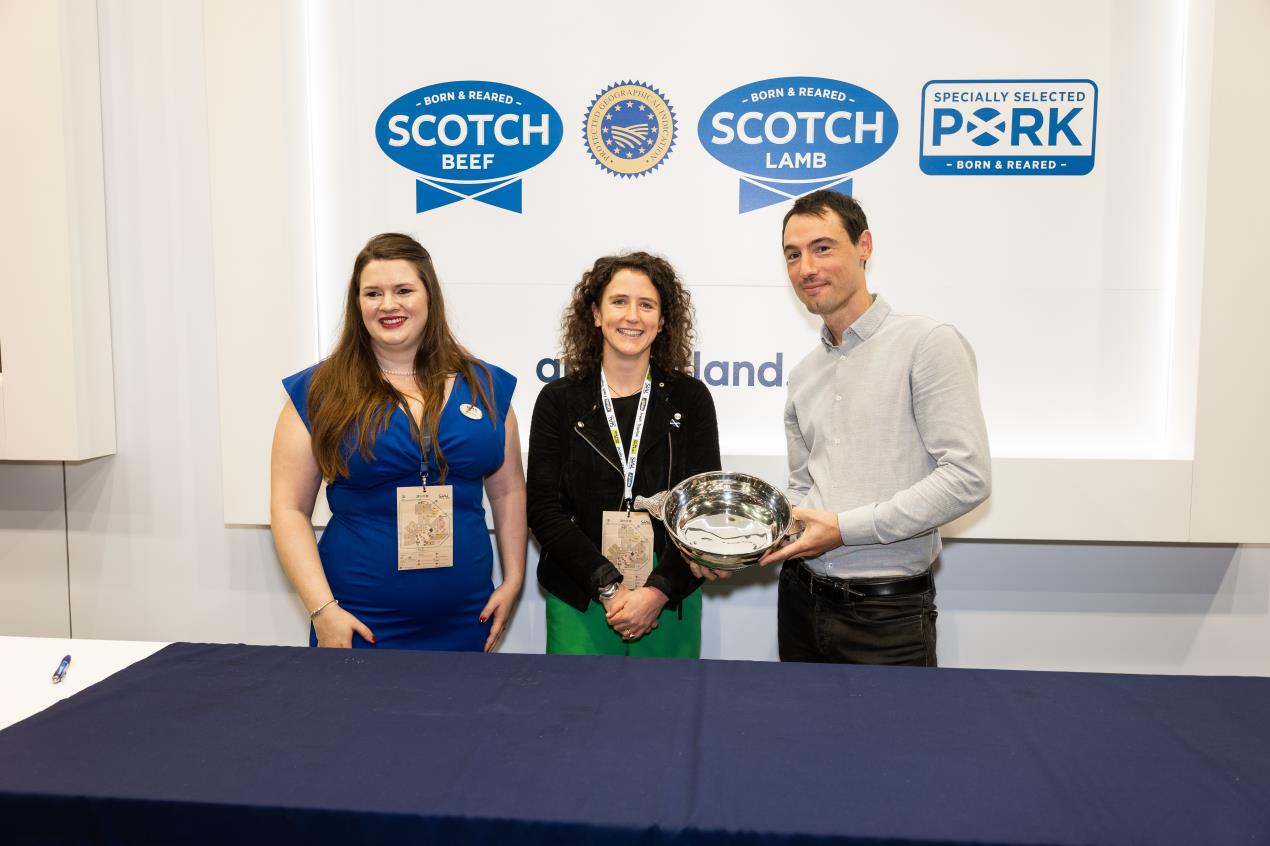
(L-R) – QMS Chief Executive Sarah Millar, Cabinet Secretary Mairi Gougeon and representative from Lesage and Fils
Buyers at Lesage & Fils praised Scotch for its consistency, tenderness and appropriate fat cover that appeals to their markets.
“We are proud of the long-standing partnership we have built with Lesage & Fils and are delighted to see them recognised for their loyalty and commitment to championing Scotch Beef,” said Niall Brennan, UK Sales Director (Primary) at Dunbia. “Partnering with high calibre importers who promote the quality and add value to the Scotch brands is at the core of our industry’s success and we look forward to seeing continued demand for Scotch Beef over the coming years.”
Nice To Meat + AK Stoddart
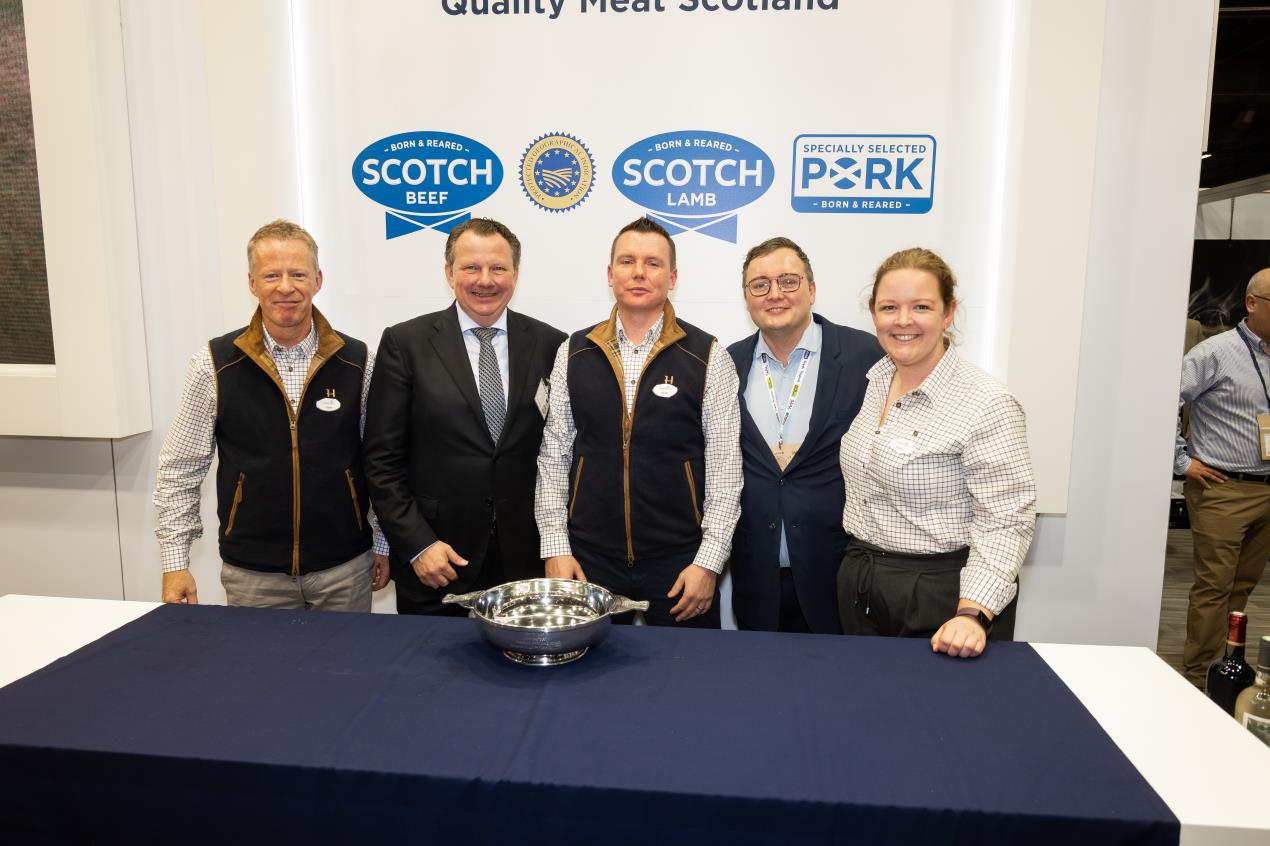
Representatives from Nice to Meat
Also receiving the Scotch Beef Distributor of the Year accolade, Nice To Meat has been working closely with Broxburn-based AK Stoddart since 2019, with sales growing 180% year-on-year, and this trajectory is set to continue.
Commenting on the relationship, Grant Moir, Managing Director of AK Stoddart said: “We are delighted that Nice To Meat has been recognised by QMS for their commitment to Scotch Beef PGI. Passionate about the values that align so closely with our own in terms of quality, traceability and sustainable rearing, we look forward to working together as we continue to serve our global markets.”
Macquet + Scotbeef
Working with Scotbeef for over 50 years, Macquet supplies Scotch Lamb and Scotch Beef to the retail and food service sectors in France, marketing Scotch as quality products and positioning them in a premium range.
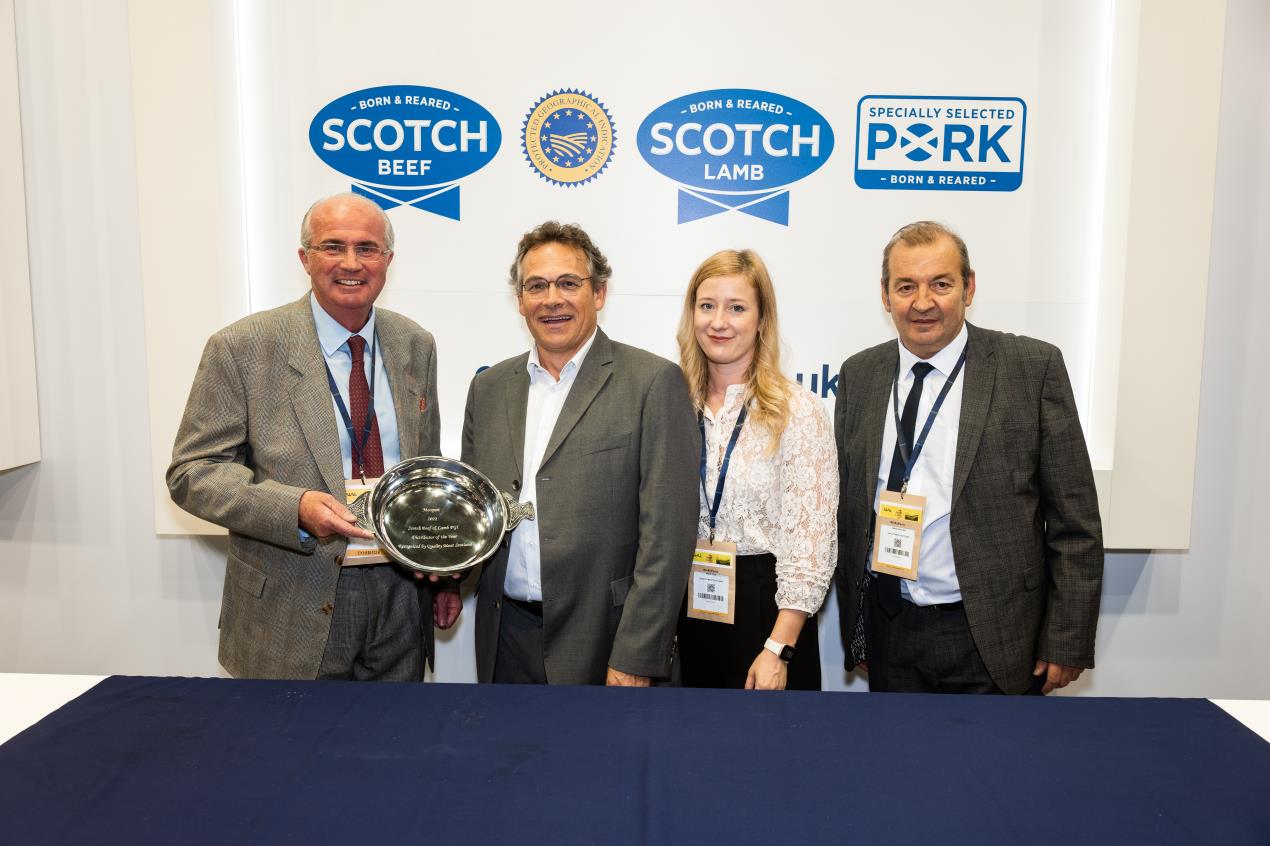
Representatives from Macquet
Simon Dowling, Director, from Scotbeef said: “Despite Brexit, the pandemic and other market challenges, Macquet has continued to build trade with us over the decades. And aside from our consistent trading relationship, they have been an avid supporter of one of Scotland’s largest agricultural events, the Scottish Premier Meat Exhibition, for the past 30 years, sponsoring the best export lamb.
“As such strong advocates for Scottish red meat, we were thrilled to see the Macquet Family recognised by QMS at SIAL.”
During the event, Ms Rowell took the opportunity to highlight the importance of international trade and reinforce the credentials of the Scotch brands:
“Scotland is now, and shall continue to be, open for business,” she said. “We are committed to strengthening our much-valued relationships with overseas customers, who acknowledge and embrace the high standards and quality beef and lamb reared by Scottish farmers. With our abundance of natural grazing land, over supply of fresh water and world class animal welfare, Scotland is the perfect place to produce natural red meat products.”
Food & drink market trade specialists visited Scotland this week to experience what sets Scotland’s red meat apart.
As part of a trade tour to meet food & drink producers and processors organised by Scotland’s trade and inward investment agency, Scottish Development International (SDI), 25 global and domestic trade specialists heard first-hand from key industry contacts to understand what makes products from Scotland different.
Quality Meat Scotland (QMS) supported with visits to an Aberdeenshire beef farm and a processor near Edinburgh.

“Scotch Beef is considered some of the finest beef available anywhere on the planet, and it is hardly surprising that exports are growing annually,” said Roisin Turner, who runs AK Stoddarts’ export business. “On Monday 3rd October, six of SDIs global market specialists attended a special tour of AK Stoddarts in Broxburn. Covering a broad range of markets including Singapore, USA, Japan, France and Italy – the group learnt about the Stoddart’s practices and processes which make it ‘Best In Beef’. Stoddart’s are proud of our export credentials and look forward to working with the SDI team to continue to expand our export markets. Having these contacts in market is vitally important to open new markets. From offering advice on local customs to liaising with Government officials on Import laws – the in-market specialist teams provide an essential service, which without would make it extremely difficult to launch into new markets.”
QMS Director of Market Development, Tom Gibson, said: “There’s no better way to market our product than giving a first-hand experience of what is behind the Scotch Beef, Scotch Lamb and Specially Selected Pork brands. This was a really valuable opportunity to build relationships and demonstrate the ‘why’ to those who are helping sell our products across the world.”
Aberdeenshire beef farmer, David Barron, who is also vice-chair of the Scottish Beef Association, showcased animal welfare and sustainability on his farm, alongside a presentation from QMS Head of Industry Development, Bruce McConnachie.
At leading Scottish processors AK Stoddart in Broxburn, Sales Manager Brian Chapman and General Manager Brian Steven gave a tour to explain product sourcing and producer groups, processing systems, product selection for customers and an overview of different cuts, customer specifications and dry aging.
QMS’ Mr Gibson followed this with further detail on carcase balance, the Scotch and Specially Selected Pork proposition in international markets and the role of QMS in developing new markets, potential international target markets for Scotch and the importance of exports to the Scottish economy.
Ewen Cameron, Global Head of Trade, Consumer Industries, at SDI, said: “We spent two very inspiring days meeting with companies and partners across Scotland with our trade specialist colleagues, 12 of whom are based overseas. It is so important when you are selling Scotland to have the opportunity to visit and hear first-hand from farmers, fisherman and processors about everything involved in producing high-quality, premium Scottish food and drink.”
On behalf of all our members, associate members and everyone connected with the Scottish Association of Meat Wholesalers it is with great sadness that we mark the passing of Her Majesty Queen Elizabeth II. She was a truly remarkable person who had a strong passion for all things Scottish; she will be greatly missed by the entire nation.
* * *
UECBV Team: We are sending our sincere and deepest condolences to you and the British people on the passing of Her Majesty Queen Elisabeth II, ending a generation-spanning, seven–decade reign that made her a beacon of stability in a tumultuous world. Her legacy will be remembered for many years.
Congratulations to Charlie Munro, his family and the team at John M. Munro Ltd. on their centenary as a business and on their vision to keep moving forward as the next 100 years begin.
Founded in 1922 by Charlie’s great-grandfather, Hugh Munro, the business has passed through many extensions and expansions over the years with the Dingwall core of the operation being altered and up graded on no fewer than 14 different occasions.
There have been more than sufficient industry crises to negotiate during the company’s history, most notably foot and mouth outbreaks, recessions, and the devastating impact of BSE. Surviving any one of these would be laudable. To survive them all and to be ready for whatever the next few years may bring is beyond impressive.
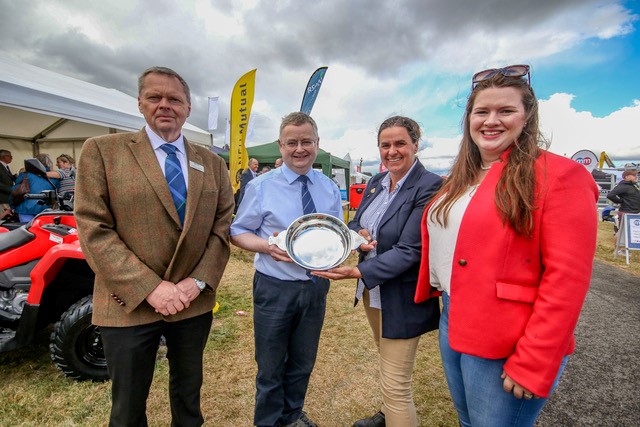
Charlie Munro accepting a centenary quaich at the Black Isle Show in August from Quality Meat Scotland’s Chair, Kate Rowell, Chief Executive, Sarah Millar and NFUS Vice President, Andrew Connon.
Founded as a quality outlet serving local outlets, the business today continues to be renowned as the source of top-grade meat for independent butchers throughout the north of Scotland, plus a growing number of retail customers in Glasgow and the central belt.
There have also been a few special ventures beyond the company’s traditional highland marketplace. The 1970s and 80s, for example, saw regular shipments of meat to the London market and on into the surrounding area. First class travellers on Concorde were also able on enjoy sirloin and fillet steaks from John M. Munro as they made their three-hour flight from London to New York.
While such a trade was a far cry from the single shop in Conon Bridge where the business started, the company’s Ross-shire roots and family foundation have remained 100% at the heart of the success of the business. Currently run by Charlie (with his 88-year-old father, Eric, still following each new development of the business), the 2022 operation employs nearly 100 people, spread between six local retail outlets and the Dingwall-based abattoir and wholesale division.
“We are in the relatively unique position of being long-standing retail butchers ourselves while also supplying other retail butchers across the region,” said Charlie. “As such, the confidence we have in our continuing role as independent retailers in our own right, stands as a sort of confidence boost for others. It is also a business we know well, simply because we’re in it ourselves and can therefore supply our retail customers from a strong, personal knowledge base. It’s an approach which has worked well for 100 years, with a lot of good stuff along the way.
“Basically, we do our own thing as best we can, we keep investing and investing, and with the right energy and resources being applied to the business, we will keep progressing.”
With 17 apprentices attached to the company this year, the family’s enduring vision for the future remains as strong as ever. That’s despite Charlie’s assessment that current pressures on the industry are ‘at the top end of the turmoil scale’ in terms of his time in the business.
“Given the war in Ukraine, rising energy costs, post-Brexit form filling, and the squeeze on household budgets, I don’t think we’ve ever seen such a combination of things being thrown at the same time as we do at present,” he said. “The biggest crisis during my 30 plus years in the business was BSE, which changed things drastically, almost overnight. We did well as an industry to recover from that and carry on.”
In facing the current challenge, however, Charlie’s view tends towards a ‘back to basics’ approach, under which customers may need to become more accepting of whole carcase purchasing.
“The time may be coming when buying a single ribeye won’t be acceptable. Instead, retail customers will need to buy a whole roast and work on how to sell the rest of it. The same with orders for a rack of lamb. The answer could be, well buy the whole lamb and sell the rest yourself. Or, if a customer says send me a pallet of silverside, the obvious answer is why should I, as that will screw up the value of every other cut. No, no, just buy five sides of beef and do the work yourself.
“Ultimately, the meat trade has always been here to put mince on plates and to make sure people don’t starve. Anything beyond that in terms of added value is a bonus. Let’s not forget that we’ve existed for 100 years by taking good quality livestock from local farms and suppling good quality meat to local butchers. That’s been our foundation.”
Finally, a brief word on Charlie’s involvement with SAMW as a member of the executive council.
“It’s good, as a small business, to be part of the loop, alongside the industry’s bigger guys,” he said. “Industry decisions, taken largely on behalf of the big guys, filter down to us and are therefore also actually taken on behalf of us as well. Any lobbying to parliament, discussions with QMS or FSS, usually benefits us one way or another, whether it is restraining FSS’s outrageous charges or arguing whether such charges should be levied at all.
“It also gives us credibility across the industry in that we are sitting at the top table with everyone else. We generally all have the same hassles in our day-to-day business, after all, so it’s good to share the burden and the pain when it happens.”
“Thank you everyone for your good wishes this year. Sometimes it’s nice to sit down and consider the 100-year achievement and say “aye, we did ok!” Charlie
John Scott Meat, founder members of SAMW, trace their progress from 1968 to the present day
From humble beginnings selling eggs and cattle from the family farm to their local butcher in 1968, John Scott Meat has evolved into a successful family business selling Scottish Beef and Lamb directly to independent butchers, Smithfield market and high-end restaurants across the length of the UK.
From their facilities in Paisley, the company now processes 15,000 cattle and 16,000 lambs a year, producing what the customer wants, which is not only important for the company but is something that is encouraged at farm level. This has involved moving away from finishing livestock at any age or bodyweight, which often results in an inconsistent end product, to focussing on steady growth on controlled rations, all built to produce a high value end-product at the desired size and quality, as demanded by the client and subsequently the consumer.
This is particularly important in the UK, where we have such variation in breeds and feeding systems resulting in carcasses often covering a wide range of ages, conformation and eating quality, which are hard to sell and quickly reduce the average achievable selling price. The company’s aim is to source cattle and lambs within a well-defined carcass criterion to guarantee a consistent eating experience, attract the highest possible price and help grow their client business by boosting consumer confidence.
Another benefit of matching the quality of each carcass with the requirements of each individual client is that, over many years, John Scott Meat have been able to establish which feeding practices, breed and age produce the best results for each end market. This invaluable information is often used by producers to adjust feeding and management strategies to produce a carcass that is consistently at the ideal weight, fat score and composition and achieves the highest possible price.
One example of this is the trade with clients at Smithfield who value a smaller carcass with high level of marbling and creamy fat cover. To meet these specific requirements, Simmental cross heifers are reared at grass before being finished at 22 months old on a 50:50 TMR mix of grass silage and a be-spoke finisher blend, containing high levels of alkaline Alpha Barley and Alpha Maize for colouration and marbling.
“The heifers have been flying on the new finishing ration, with excellent fat cover and grading out extremely well at R3/4L with nice creamy fat cover,” said Jamie Scott. “Carcass weight and confirmation were exactly where we need them to be and the heifers are like peas-in-a-pod, which is exactly what we are looking for. We even finished lambs ad-lib on the same finisher blend, with no signs of gravel, excellent dung consistency and the lambs easily achieving our target of U/R3L at 23kg deadweight.”
Her Royal Highness The Princess Royal has officially opened Dunbia Highland Meats’ upgraded abattoir and cutting facility in Saltcoats.
Alongside the royal entourage, representatives from Quality Meat Scotland (QMS), the Scottish Government, retail customers, and farmers that supply Dunbia Highland Meats were among those attending the opening ceremony on March 31, 2022.

Princess Royal with Niall Browne CEO of Dawn Meats
“It was an absolute pleasure to have The Princess Royal open our new facility,” said Niall Browne, Chief Executive of Dunbia (UK).
“We are immensely proud of the enhanced plant which allows us to process the highest-quality Scotch Beef products for Scottish, British, and overseas consumption.”
Kate Rowell, Chair of QMS commented: “The visit not only provided the opportunity for us to showcase more about the production of top-quality Scotch Beef PGI, but allowed stakeholders from all stages of the supply chain to come together and celebrate innovation and progress within the red meat industry.”
MacDuff 1890, a family business dating back to the 19th century, recounts its trading experiences in the post Brexit era. Andrew Duff, Director, MacDuff 1890, writes:
Effectively, since 1 January 2021, we have been unable to export our products to our long established and loyal customers in the EU. Why is this you may ask, well in the run up to leaving the EU, the UK Government gave precious little consideration to the impact that moving to 3rd country status would have for smaller businesses like ours, who have to rely on grouping products together with other exporters into consolidated loads to help minimise transport costs.
It quickly became apparent, however, that such groupage was fraught with problems once we embarked on post Brexit trading. Huge issues arose in relation to our EU exports with the groupage method which worked so well before, suffering severe delays as physical and documentary checks were conducted on all vehicles when entering the EU.

Andrew Duff being interviewed for BBC Scotland report on export issues
The extra bureaucracy, red tape and paperwork involved in such exports, alongside the delays with border checks etc., made it uneconomic for us to continue shipping product into the EU at the time. Many companies we had previously used as hauliers to export via the groupage method into the EU, were then refusing to accept our goods as they faced the very real risk of getting stopped for hours, if not days, at the border. And, just to rub salt into our wounds, we had to pay a vet to sign our export health certification, a step was added yet more cost to the process.
As we are a small business, we had to use groupage, as we cannot fill a whole wagon ourselves. Larger businesses who could fill whole wagons, and so avoided groupage problems, have still experienced issues with Brexit, even though they were still managing to get product into the EU post Brexit.
Furthermore, due to us not having a distribution hub in the EU, delivering to individual addresses/butcher shops across different countries in the EU made it a severely difficult task. Towards the end of 2021 there was only one company that was successfully exporting products of animal origin from Scotland to the EU.
So, what did we do instead?
With the EU effectively a no-go area for business, we decided to diversify by branching out into retail last year. We successfully launched an upmarket butcher shop within the centre of Edinburgh last summer, which supports a lot of local suppliers as well as selling our prime beef, lamb, and pork. We have also started to ship products out to Hong Kong through a UK based company that has links with Hong Kong. This is proving an exciting venture. However, the irony of being able to ship product halfway around the world but not to mainland Europe is not lost on us.
Is there any light at the end of the tunnel on the exporting front?
As of today, we finally have two companies that say they can potentially export smaller consignments to the EU. We are now working out costs and all the administration that surrounds this option so we can try get it set up and going again. So, potentially, MacDuff 1890 will soon be exporting its native breed beef to the EU again, although there are doubts at present as regards additional cost factors and the length of time since our customers have dealt with us. Whether or not they will be willing to pick this business up again, as easily as it was pre-Brexit, remains a key question.
Here’s hoping!
Ian Bentley, SAMW President, outlines his vision for the Scottish red meat sector in 2030
Those of us who remember our last Conference and compare it with this one, you must feel a bit like Rip van Winkle. Here we are again, but in a world that has changed hugely while we were away. I don’t need to go through the list of events, any one of which would seem earth shattering on its own, yet we have faced a host of them, one after the other, and all making life more difficult and uncertain.
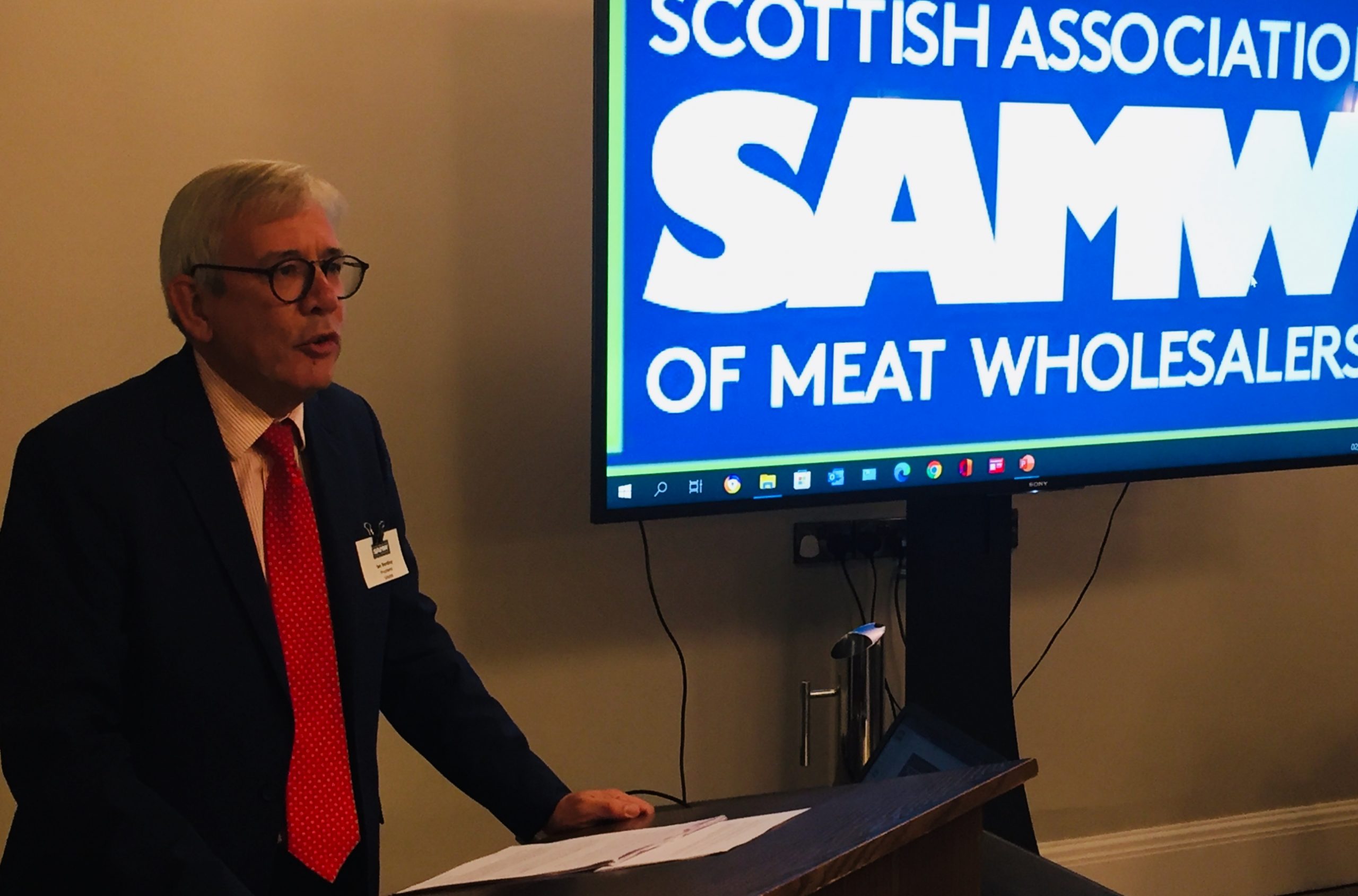
Ian Bentley
I do not want to dwell on these issues, we hear enough about them every day, but that is not to pretend they are trivial matters – they represent serious threats to our industry in the here and now. Today, I want to look forward with some optimism about the Scottish meat industry, and to sketch out a vision of what things could be like by the end of this decade, if, and it’s a big if, we all think about what is right for the industry as a whole and take the right decisions and actions within the supply chain, and in the seats of regulatory power.
So, bear with me, I have a dream.
Sensible objective analysis
Let’s consider a 2030 where the meat industry is no longer seen as the root of all evil. Why? Because the smoke and mirrors around health will have been cast aside by sensible objective analysis, and the moderate consumption of red meat will be recognised world-wide as an essential part of a healthy diet. I have no quibble with people who follow a particular diet through personal choice. I do have a problem with pressure groups and vested interests who seek to attack our industry with distortions or, as people say now, “alternative facts”. I hope that within a few years those falsehoods will be exposed.
A 2030 world where the truth about levels of net carbon emissions produced by different methods of rearing livestock, are being accurately measured. And by net carbon I do mean net, so that the carbon storage of pasture, hedgerows and trees across our fields are included in the calculations. By then, hopefully we will have a clear picture about good and bad practices, and we will be on the way to promoting the good systems and eradicating the bad, helped by a Government which rewards the good, and supports a Scottish red meat industry for the long term.
By 2030, I would hope to see red meat exports from Scotland going across the world, in recognition of the quality and sustainability of our product, and hopefully by then no longer hobbled by export regulations which seem to do everything possible to discourage trade rather than promote it. Government has a part to play in removing these obstacles. Then trade bodies and our members need to capitalise on the opportunities which will emerge.
Technological and information revolution
In our own markets, I would like to see a recognition of the true costs of meat production, and a reflection of those costs through the supply chain. So, that means dearer meat for the consumer, I hear people say, and that may be so. But, I also think that may be a 20th century state of mind. Today and in the future, our industry needs to embrace the technological and information revolution which is transforming other industries. The use of data analysis for soil, feed and rearing at the producer level; artificial intelligence and robotics for processors, pinpointed distribution at retail levels to reduce wastage.
All these can drive out costs and improve margins without simply passing on higher prices to consumers. We have vets and meat inspectors present in all of our plants, working in ways that are no different from 10, 20, 30 years ago. Will we have the same in 2030? Or will we have harnessed the power of data reporting, remote visual access and AI to create a new model which works better and reduces costs, rather than simply ratcheting up year after year? I would hope we can get to that, but trials need to be formulated now and put in place as soon as possible.
And perhaps this is an example of something else I would like to see by 2030. We all talk about how “the industry needs to work together to solve the problems which face all of us”. How often we say that – I say it myself. How often does it actually happen? When an issue arises, each part of the supply chain is quick to defend its own position, perhaps because of the insecurity which low profitability brings.
Support – fair prices – strategic relationships
Perhaps by the end of the decade we will have a farming sector which feels supported by Government and which has established fair price agreements with processors, processors who are in long term strategic relationships with retail customers, and Government bodies which see their role as supporters, facilitators and, yes, upholders of a vital and growing Scottish industry.
Maybe my picture of the future is very rose tinted, but I do believe if we genuinely work together then much of it may come to pass and these gloomy days can be left behind. I know I and all of our members would wish that to be the case.
T: 07768 654955 E: scott.walker@scconsultancy.uk
© samw.org.uk - All rights reserved - Scottish Association of Meat Wholesalers | Privacy Policy