T. 07768 654955 E. scott.walker@scconsultancy.uk
Scotland’s meat industry is at risk of being rendered ‘uncompetitive’ in comparison to the rest of the UK by the imposition of huge cost increases by Food Standards Scotland (FSS).
An April 1st price hike by FSS of 20% for the provision of Official Veterinarians (OVs) and a 17% rise in the cost of Meat Hygiene Inspectors (MHIs) has been described as excessive and unacceptable by the Scottish Association of Meat Wholesalers (SAMW).
“The Food Standards Agency (FSA) in England and Wales is, in contrast, raising its OV rate by 4% and MHI rate by 10%, leaving both charges well below the levels our members are being required to pay,” said SAMW President, Ian Bentley. “If the FSS increases are allowed to stand without any abatement, they will impact our businesses, the staff our members employ and the wider farm-based rural economy from which we draw our raw materials.”
SAMW has discussed the issue with senior staff at FSS and written to the Scottish Government Minister for Public Health, Jenni Minto, warning that the planned 20% and 17% cost increases ‘will have a detrimental effect on the industry’ to the extent of ‘jeopardising’ member businesses ‘competitiveness and sustainability’.
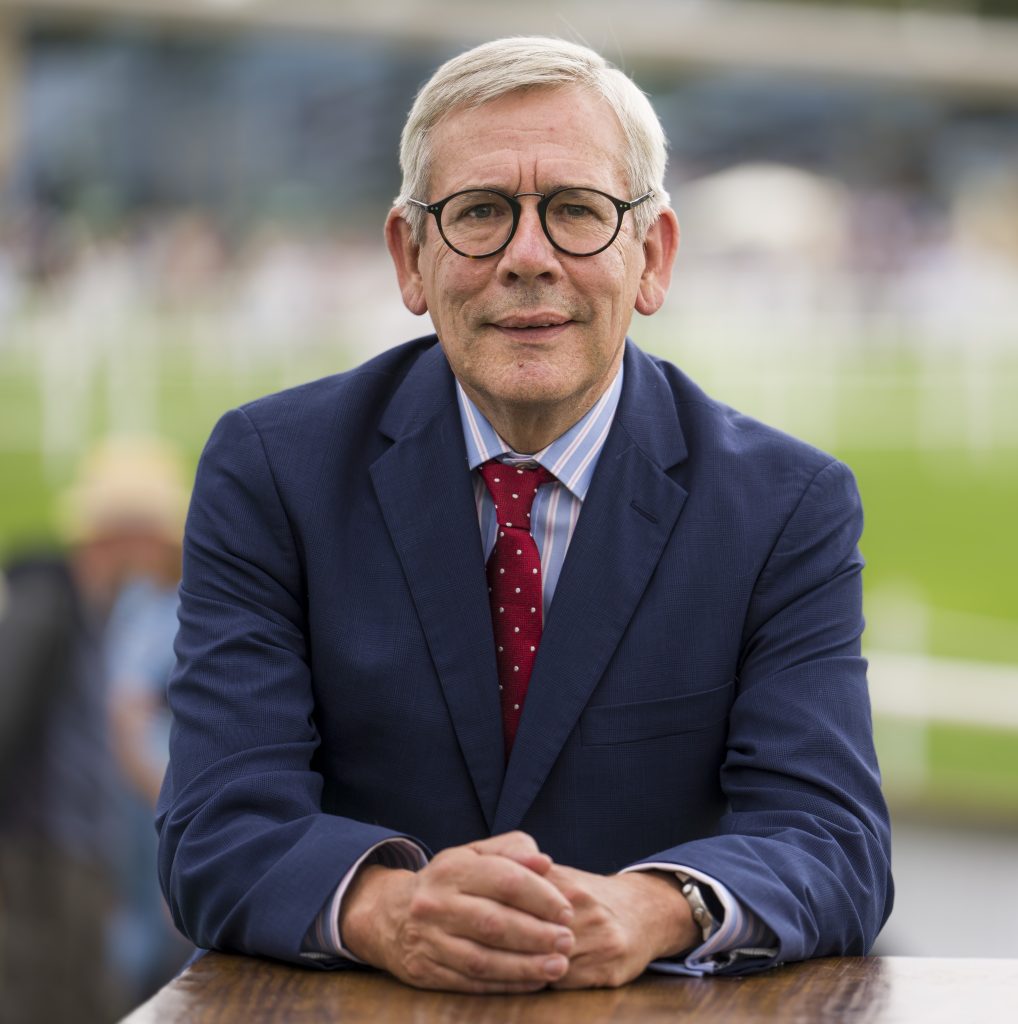
Ian Bentley
“Individual members are shocked at the level of OV and MHI increases they are now facing, especially when compared to their own efforts to keep processing plant cost rises closer to the 4% level which FSA is achieving,” said Mr Bentley.
One business owner said he would never be able to negotiate a 20% rise with his own customers and would never accept such an approach from a commercial supplier. Another business executive commented that if FSS was his supplier in the commercial world then it wouldn’t be his supplier anymore.
“We understand the pressures under which FSS has been operating, with its need to absorb the Scottish Government’s civil service wage rise of 7% for 2023/24 and the introduction of a 35-hour-week from October this year,” said Mr Bentley. “According to FSS, this equates to a cost recovery requirement of £424,000.
“Our members are perfectly happy for the Scottish Government to takes such steps, of course, especially if they can fund the increased costs. We just don’t see why we should pay for them.
“The other major cost increase, as identified by FSS, relates to difficulties it has experienced in recruiting sufficient OVs and MHIs to operate the statutory controls in Scottish red meat plants. While, ideally, these posts should be filled by employed staff, FSS has relied ‘as a temporary measure’ on agency and locum staff at an additional cost to their budget of £407,000.
“Here again, member companies do not see why they should be required to pay for this ‘temporary’ cost, caused by the described recruitment ‘difficulties’.”
Scotland’s red meat sector benefits from an annual discount of statutory charges, worth £1.07 million, a measure which acknowledges the industry’s contribution of £1 billion a year to the Scottish economy and a direct employment base of over 3000 people.
“We firmly believe therefore that a strong rationale exists for the industry discount to be temporarily increased to offset the £831,000 added burden we are currently facing, a request we have already made to the Scottish Government,” said Mr Bentley.
“We are also seeking, even at this 11th hour, a postponement of the April 1st increases to allow the matter to be examined and discussed in greater detail than has been possible since the 20% and 17% figures were presented to us on March 7.”
It’s unnerving how much change has taken place over the past 12 months while, at the same time, how little has been achieved in terms of policy advances or the delivery of solutions to benefit Scotland’s red meat chain either in 2024 or beyond, says Ian Bentley, President of the Scottish Association of Meat Wholesalers.
Ian Bentley
“Balancing positives and negatives is a common element of business management across all sectors, of course, especially when energy costs remain high, inflation and interest rates plague us all, and cost of living pressures constrain consumers’ spending powers,” he said in his annual New Year summary.
“For Scotland’s red meat industry, in particular, 2023 will be noted for a degree of business upheaval, driven by changes of ownership, although it’s encouraging that we have suffered no loss of processing capacity during this process.
“More worrying is the continuing annual decline in livestock numbers, despite relatively strong prices for producers throughout the past year. While the decline in 2023 has been small in percentage terms, the drip, drip, impact on our shrinking breeding herd is approaching a critical point.
“I have said before that this should be a source of concern to Government and a stimulus to move forward with an agriculture policy which recognises the importance of the meat industry to Scotland’s economy and incentivises increases in sustainable production. However, we are still to see any detailed proposals along these lines, and I fear that continuing uncertainty will result in a further reduction in numbers in 2024.
“This trend has several consequences. One is that a reduction in domestic production opens the door to increased imports of meat from across the world, potentially from countries whose standards of quality, welfare, and sustainability are inferior to our own. This surely cannot be right, yet some of the recent trade deals agreed by the UK Government seem expressly designed to open up our country to these sources.
“Given that our climate and terrain is ideally suited to farming for sustainable meat production, we should be promoting and supporting our domestic industry rather than undermining it, as so often seems to be the case. I hope that in 2024 we shall start to see positive signs in this direction.
“We also hope for sensible moves in relation to the regulation of our industry. All too often, regulatory friction inhibits trade, as we have seen in recent months with the introduction of vet attestation requirements for exports. It is difficult to justify this additional bureaucracy and we hope it will not hinder trade through 2024.
“The processes surrounding vet attestation is a prime example of low policy implementation in both 2022 and 2023. Originally scheduled for launch in December 2022, the policy was first delayed until December 2023 and is now scheduled for practical introduction in April 2024. All that has been achieved so far is uncertainty for those seeking to run commercial meat export businesses.
“In addition, the attestation requirement appears set to add to difficulties already being encountered concerning the availability of sufficient qualified vets to keep our industry running smoothly. Vet recruitment is fast becoming a major issue across the country, indeed across the world, and tying up the vets we already have with ever more form filling is a poor use of their expertise.
“We remain positive and upbeat about the quality base on which the Scottish meat industry is founded, nevertheless, from stock breeding through processing to strong trade contacts at home and abroad. These factors have never been in doubt. It would be helpful though if some of the limiting impacts I’ve already mentioned are properly and finally dealt with in 2024. That is certainly our hope for the new year.”
QMS proposal: QMS is asking the industry for an increase in the red meat levy to deliver the priorities outlined in its new five-year strategy. From spring 2024 it is proposed that the red meat levy will increase each and every year for the next five years by the rate of inflation, as measured by the Consumer Price Index (CPI). Over the coming weeks QMS will finalise its draft business plan and will present this to producer and processor levy payers via a series of levy payer workshops in November and December, as well as one-to-one meetings with processors over the same time period.
SAMW comment: “A properly resourced QMS is important to promote our products, to seek new markets at home and abroad, and to defend our sector’s reputation,” said Scott Walker, Executive Manager for SAMW. “In this context, we are not opposed in principle to a change in the levy rate, but we need to be convinced of the benefit of the activities on which the levy will be spent.
“We look forward to discussing with QMS their new 5-year business plan for implementing their new strategy. Value for money must be evident in everything QMS does. We are not against a new long-term funding mechanism and will consider what is being proposed against what we see in the new 5-year business plan. Levy rates need to be justified and increases should not be taken as a given. Our member companies, for example, have to earn their income increases on a day-to-day/month-to-month basis.
“We want to see clear outputs that benefit the industry from the activities undertaken by QMS and clear timelines for achievement. Regular reporting on the progress made against targets is needed to give us confidence that value is being secured from the levy collected.
“We will be judging the merits of an increase in the levy by the actions proposed in the business plan and will comment more fully once we have seen the details of the business plan.”
HCC & AHDB levy action
In addition to the levy plan advanced by QMS, both HCC and AHDB have already announced their own rate increases.
HCC levy rates increased by 10% in April 2023 and will going forward each and every year from now on in line with the annual inflation rate, as measured by the consumer price index including owner occupiers’ housing costs.
AHDB is proposing a different approach to both QMS and HCC. Instead of following an annual inflation-based system, AHDB is proposing a single uplift in 2024 of 25% for the cattle & sheep levy rates and 20% for the pig levy rate.
Speech by SAMW President, Ian Bentley, delivered to the annual conference in Edinburgh on September 1, 2023.
Cabinet Secretary, ladies, and gentlemen, it is a pleasure to welcome you to this year’s SAMW Conference. A year ago, we were cautiously celebrating the relaunch of our Conference after the years of the pandemic, while at the same time feeling the uncertainty of a world changed by an outbreak of war and strong economic head winds. Some of those uncertainties turned into reality and we are still dealing with them, but the impact of others, for example energy costs, have alleviated slightly.
Ian Bentley
As is right at our conferences, we aim to look forward rather than back, and I believe our invited speakers will help to illustrate for us what the future may look like and what we in the industry need to do to ensure it materialises. As always, there is much for us to do, but my main message is that Scotland’s meat industry needs help. We need help to reverse the long-term decline in livestock production in Scotland, a decline which, if it continues, will ultimately call into question the viability of our industry.
We know that at times over the years producers have been critical of farmgate prices, and this was often cited as the reason behind falling numbers. But returns over the past couple of years have improved considerably, yet we have not seen the stimulus to production which we might expect. Instead, the slow downward trend is continuing. I believe this is because we are not seeing the development of a clear, unequivocal policy of support and promotion for Scotland as a key producer of quality meat on the domestic and world stage, a policy which is actively encouraging and incentivising quality livestock production using sustainable practices. The absence of this clear policy harms confidence and contributes to the decline in numbers.
We welcome the boldness of Quality Meat Scotland’s 5-year strategy, but it needs to be underpinned by Government policies which are aligned and designed to make that vision happen.
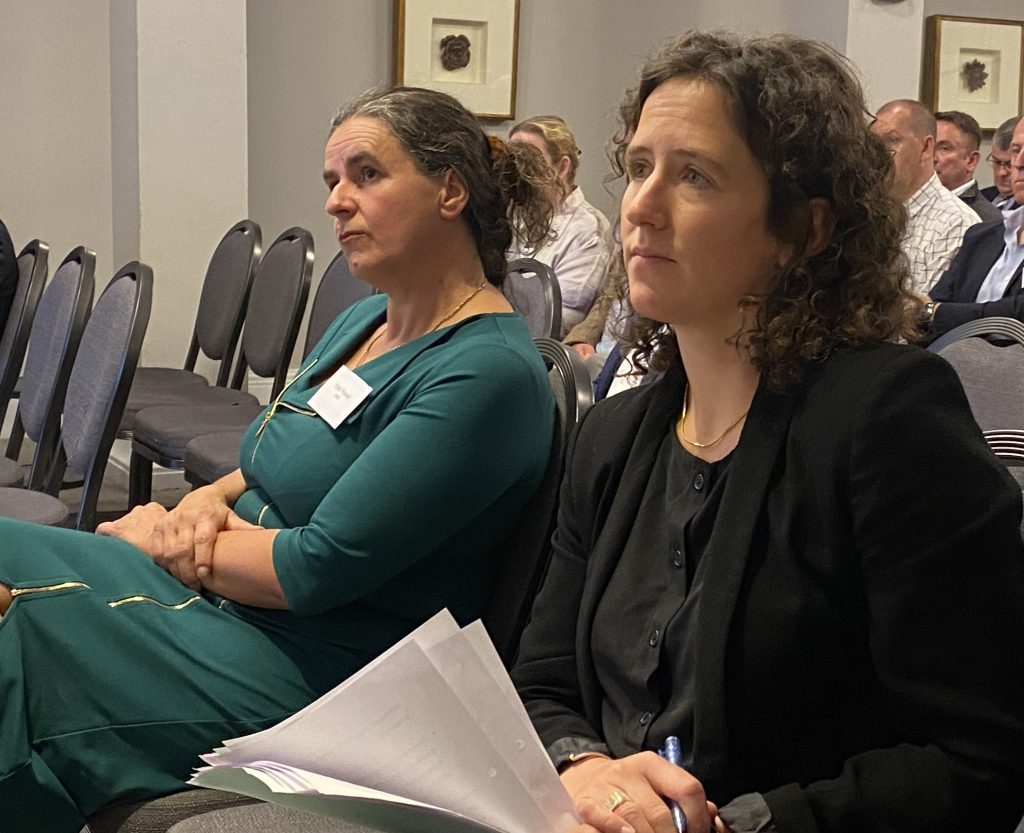
Intent listeners to SAMW President’s speech: Kate Rowell, Chair, QMS, (left) and Mairi Gougeon, Scottish Cabinet Secretary for Rural Affairs.
Scotland is one of the best places in the world to raise livestock for high quality meat in a sustainable way. We have water, we have grass, we have a temperate climate. We have very high standards of animal welfare and regulatory oversight. Despite the regular bashing which meat gets, consumers in many countries are proving to be very loyal to an omnivorous diet, and we know that as prosperity grows in emerging countries, their populations want to, and will, increase their consumption of meat products. Scotland should be gearing up to meet this increasing demand by introducing policies which support increased sustainable production.
But we are not alone. Other nations have recognised these global trends and are responding to them with coordinated activities which are designed to demonstrate the positive attributes of their production. Scotland needs to be joining, and winning, that race.
There is much for us to do as an industry. Carbon is a good place to start – there are great examples in our industry of advances in moving towards net zero. I suspect, however, that we are not doing enough to raise awareness of our progress so that we are not an easy target for those who delight in campaigning against meat production because of emissions. Emissions are not a reason to abandon or even reduce production in Scotland. Instead, emissions should be the subject of funded research and rational investigation to find the best way of minimising them, while also recognising the positive sustainable credentials of extensive production on grass. The easy answer – to reduce livestock numbers in Scotland – will simply encourage production in other countries which could be much more harmful to the environment.
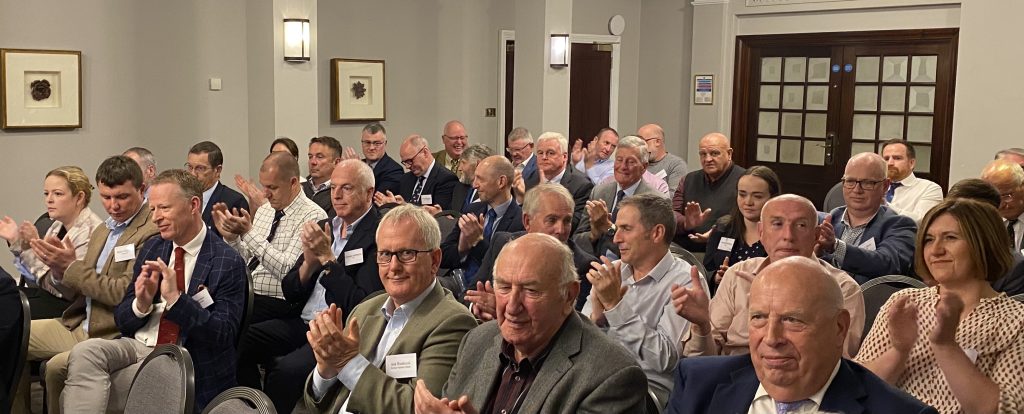
An appreciate conference audience
Human health is another area for our industry to get its act together, but with strong sustained support by policies. We are starting to see a more sober and balanced attitude to meat eating emerging from opinion formers but there is more to be done. This year’s big target seems to be ultra processed foods and their detrimental impact on our health. So, other than a raw carrot, I ask you – what could be a less processed food than a steak, a chop, or a roasting joint? Meat substitute product ingredients lists read like a chemistry set. The ingredients list for a piece of meat, in contrast, is relatively short to the tune of one. But I don’t hear the pundits recognising the simple fact that meat is a natural unprocessed food with lots of essential health-giving attributes. We need to do more to get these messages across. We are not helped, however, when official bodies start taking pot shots – please help us to ensure a rational and sober presentation of the facts.
We have an industry of which Scotland can be proud and is indeed recognised worldwide as a source of excellence. I was in a supermarket in France recently which was proudly promoting its beef as Aberdeen Angus – an industry which should be seen as an opportunity for Scotland to advertise itself as a high-quality food producer – but an industry where its raw material continues to reduce year after year.
As Joni Mitchell said about Paradise and parking lots – “You don’t know what you’ve got till it’s gone”. I urge everyone who cares about our industry, and even those who don’t, to see the opportunity and the threat, and to make sure that as new policy details emerge, they are aimed clearly and unequivocally at enabling this industry to grow.
SAMW has written to Mark Spencer, Minister of State for Food, Farming and Fisheries; Mairi Gougeon, Cabinet Secretary for Rural Affairs, Land Reform and Islands; Geoff Ogle, FSS Chief Executive; and Emily Miles, FSA Chief Executive, to protest strongly that the labelling of certain plant-based products is likely to mislead consumers and harm the Association’s meat processor members who label their meat-based products honestly and straightforwardly.
The full text of the letter is as follows:
Dear Minister
As President of the Scottish Association of Meat Wholesalers (SAMW), I would like to draw your attention to the food products shown on this website https://this.co/products/
These products are marketed by THIS and are sold widely in supermarkets across the UK. They are vegetable-based meat substitute products which are labelled variously “THIS isn’t Lamb”, ” THIS isn’t Bacon” etc. Beneath the most prominent label is a smaller description stating that they are 100% plant based. Despite the “This isn’t” label titles, the products are made to closely resemble meat products, e.g., lamb kebabs, bacon rashers etc.
We believe these products are intended to mislead customers into thinking they are actual meat products. In each case the font size of the meat word, “Lamb”, “Bacon” etc, is larger than the word “isn’t” or the words indicating that it is a plant-based product. The ordinary consumer will read the meat word, see the product which resembles the meat equivalent and quickly conclude that this is a genuine meat product, potentially dishonestly stealing purchases from the genuine meat-based product.
As there is no meat in the products, we fail to see how they can legitimately have the meat name in the product title. Our understanding is that a product title should describe what it IS, rather than what it isn’t, otherwise some very odd situations could arise, not to mention misleading ones such as these.
To be clear, we have no problem with vegetable-based products which are labelled clearly with an accurate description of what they are. However, we protest strongly that the labelling of these products is likely to mislead consumers and harm our meat processor members who label their meat-based products honestly and straightforwardly. I would ask you respectfully to consider these points and to take appropriate action to ensure that all food products are being accurately and honestly described.
Yours sincerely
Ian Bentley
SAMW President
The Scottish Association of Meat Wholesalers (SAMW) is pleased to announce the appointment of Scott Walker as its new Executive Manager.
Mr Walker, who was previously the chief executive of NFU Scotland, takes on the role formerly held by Martin Morgan who sadly passed away in January this year.
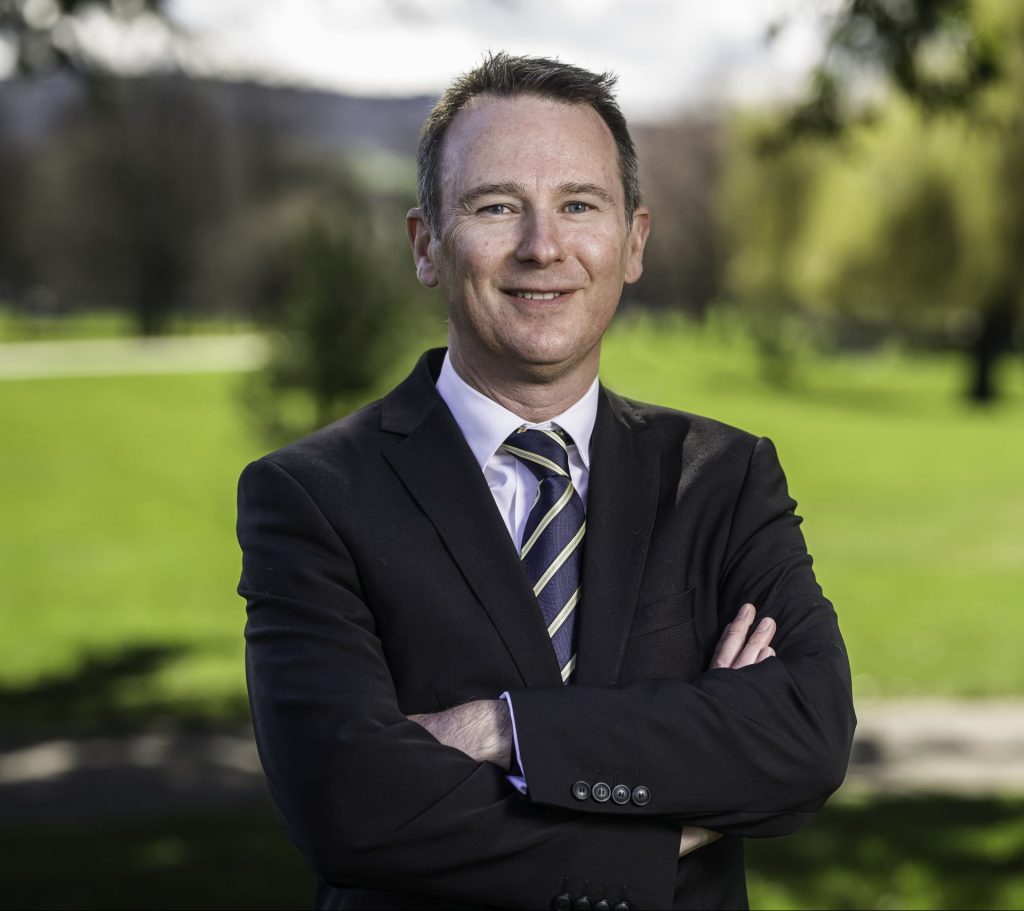
Scott Walker
“Scott joins a long list of excellent executive managers who have served SAMW over the years with Martin’s five years with the Association, in particular, marking a strong period of leadership for Scotland’s red meat industry,” said SAMW president, Ian Bentley.
“Having a person, in Scott, of such experience to now lead us forward is a boost for our members, especially following the untimely ending of Martin’s time with us. We look forward to working with our new executive manager as we seek together to keep driving our industry forward.”
Having spent the last 11 years as CEO of NFUS, Mr Walker has a deep knowledge of Scottish food and farming and a thorough understanding of the red meat sector’s many challenges and opportunities.
“Advocacy on behalf of the industry has been a major part of my career over the last decade and I look forward to fulfilling a similar role on behalf of the red meat sector,” said Mr Walker. “I’m well used to working with politicians and officials in Scotland, Westminster and on the international scene, and will be seeking to do the same for SAMW, on behalf of what is a hugely important industry for Scotland’s economy.
“We should all be proud of the quality of red meat produced in Scotland for sale both domestically and across many export markets. There is a strong story to be told and much progress to be made in the months and years ahead.”
Mr Walker will take up his new office on April 24, 2023.
“As an Association we deplore any fraudulent practices in our industry,” said SAMW President, Ian Bentley. “Events like these (NFCU investigation) bring the industry into disrepute and disadvantage the vast majority of honest operators who are grappling with the financial pressures of doing business today. These instances also undermine our efforts to reduce costly and inefficient regulatory measures in our businesses.”
Five former presidents marked the 30-year anniversary of the birth of the Scottish Association of Meat Wholesalers (SAMW) with a walk down memory lane at the 2023 New Year Lunch in Edinburgh.
The pre-lunch programme opened with a heartfelt and fitting tribute to Martin Morgan, the Association’s Executive Manager for the past five years who sadly died in the days leading up to the NYL. Delivered by close friend and colleague, Ian Anderson, the tribute was welcomed by Association members and industry guests as a special opportunity to acknowledge Martin’s diligent commitment to SAMW and members’ interest throughout his time in office.
Tribute was also paid to Doug Ward, a firm supporter of SAMW over many years and a close friend to many in the Association, who died in early January.
Presidential memories from 1989-2022

Former presidents at NYL 2023: (l-r) Jimmy Robertson, Alan McNaughton, Neil Stoddart, Allan Jess, Alan Craig, and 2023 President, Ian Bentley.
Jimmy Robertson, 1987/89, led the meeting in a look back at SAMW’s earlier days, reflecting on the beginnings of the Meat & Livestock Commission, the loss of local authority meat inspectors “who knew what they were doing” to a centrally controlled system which was “forced on the trade in a desire to be European Citizens”.
Neil Stoddart, 2000/03, took up the story with tails of working visits to Brussels, often with little reward for the industry; the start of Scottish devolution; the birth of Quality Meat Scotland, and the deeply unpleasant task of dealing with the UK’s Foot and Mouth Outbreak in 2001.
Allan Jess, 2006/09 & 2016/17, focused his comments on the vital importance over the years of SAMW’s Executive Managers, Alan Stevenson, Alistair Donaldson, Ian Anderson, and Martin Morgan. He also highlighted the camaraderie which has always existed across the SAMW membership and the commitment of many individuals who have given their time and energy to protect and develop the Scottish red meat industry throughout its history.
Alan Craig, 2009/12, spoke about the emergence of the single farm payment during his presidency and the Association’s anxiety that this would lead to a massive reduction in livestock numbers. He also dealt with the development of the Sheep Strategy Council and, as a little light relief, enjoyed revising a few sponsors’ descriptions from annual dinner speeches of the time.
Alan McNaughton, 2016/16 & 2021/22, concluded the memories session, with mention of the formation of Food Standards Scotland; debates surrounding WATOK (animal welfare); concerns of livestock supplies and the need to keep hitting the ‘in-spec’ livestock message to help reduce the number of very-fat/too heavy animals arriving at meat plants most mornings of the week.
The following former presidents were also present at the 2023 NYL:
Alan Kirkwood, 1997/2000
Isla Roebuck, 2003/06
Frank Clark, 2017/19
Andy McGowan, 2019/21
Ian Bentley, 2022 –

Teamwork at NYL 2023: (l-r) Alistair Donaldson, Andy McGowan, Allan Jess, Jimmy Robertson, Alan McNaughton, Isla Roebuck, Frank Clark, Alan Kirkwood, Neil Stoddart, Alan Craig, Ian Bentley, and Ian Anderson
It is with great sadness that we have to announce that Martin Morgan, Executive Manager of the Scottish Association of Meat Wholesalers (SAMW) has died after a prolonged battle against cancer.

Martin Morgan
Martin, who joined the Association in November 2017, will be greatly missed by SAMW’s Executive Committee, with whom he worked closely until a few weeks ago, and all the Association’s members. A former head of livestock policy for the Scottish Government, Martin started at the Scottish Office in 1977, beginning a career which included working on industry-changing meat hygiene legislation in 1992 and the BSE crisis from 1996 onwards. He was also a major part of the Scottish Office team involved in handling the UK’s foot and mouth outbreaks in 2001 & 2007.
“Martin worked tirelessly on behalf of the Association and the whole Scottish red meat sector during his five years as our Executive Manager,” said SAMW President, Ian Bentley. “He was always ready to address any issues which might impact our industry, attend countless Government and business meetings to represent the Scottish red meat sector, and serve the membership in whatever way he could. We will all miss him greatly.”
Ian Anderson, who Martin followed as Executive Manager, added: “Martin was a top rate colleague throughout our time together in the Scottish Office and an SAMW successor who I was delighted to have follow me in this role. In both incarnations, there was little Martin didn’t know about livestock farming and the food industry.
“He was also a great friend and staunch supporter, who brought so many admirable qualities to whatever he did, both as a person and in business.”
SAMW’s Executive team and members express their sadness and deep condolence to Martin’s wife Jacki and his family.
SAMW joins all-industry bodies in agriculture policy demand
The recently-established Food & Agriculture Stakeholders’ Taskforce (FAST) has challenged the Scottish Government to take urgent steps to include the farming industry in the co-design of future agriculture policy.
During a seminar at AgriScot (November 16), FAST representative, Doug Bell, called on Mairi Gougeon, Cabinet Secretary for Rural Affairs and Islands, to clarify her co-design plans, ahead of the closing of the Agriculture Bill consultation early next month.
Mr Bell, Managing Director of the Scottish Tenant Farmers Association, was speaking on behalf of FAST, an independent group of 19 organisations which represent agriculture and food production in Scotland.
Mr Bell said: “FAST is a dynamic taskforce of people with experience, grass-roots knowledge and an ardent drive to protect and promote Scotland’s agricultural and food production into the future.
“As a collective we want to work constructively with Scottish Government as it sets Scotland’s future agricultural policy. Ministers continue to propose that it is essential that the industry is central to the co-design and co-development process.
“It is now a critical time to get the policy right and we are keen to ensure FAST is part of that co-design process. It is vital to avoid the impact of an Agriculture Bill and secondary legislation which generates unintended consequences for the industry and the country.”
FAST is comprised of senior representatives of Scotland’s key organisations in farming, crofting and primary food production. The group was formed to constructively move forward the dialogue in response to an evident lack of vision, dialogue and detail being seen in the run up to and during the consultation on the new Agriculture Bill, which closes on 5th December.
Mr Bell added: “The members of each of our organisations – from livestock producers to arable growers and crofters – desperately need to understand where policy is going.
“We need to know what Scottish Government plans to do with the powers granted by the consultation, what this will mean at grassroots level and how farmers, crofters and others in the supply chain can work effectively to secure the future of their businesses. FAST is willing and keen to work with Scottish Government to ensure this is clearly defined.”
FAST will be inviting the Cabinet Secretary to meet with the group as soon as possible.
The purpose of this meeting will be to share its insights and vision for the most productive direction for policy that advances food security, food production, the environment and the country’s agricultural supply chain, as well as the industry’s significant contribution to the Scottish economy and rural communities across Scotland.
FAST members:
T: 07768 654955 E: scott.walker@scconsultancy.uk
© samw.org.uk - All rights reserved - Scottish Association of Meat Wholesalers | Privacy Policy