T. 07768 654955 E. scott.walker@scconsultancy.uk
The future level of Scottish livestock numbers remains a big concern for 2012 says Alan Craig, SAMW president.
“Despite some possible evidence of stabilisation in the beef sector, there are still serious questions surrounding high cow cull disposals in recent months and the impact this will have on future calf numbers, particularly in 2012,” he said in a New Year review of the meat sector in Scotland.
“Supplies are already extremely tight so, even if the most optimistic interpretation of current livestock figures plays out in reality, we’re still looking at another year of limited raw materials and a processing sector throughput which is well short of ideal.
“The one firm statistic we have is that the pool of breeding cattle is currently 100,000 head smaller, in GB terms, than at this time in 2010. However you view the other figures which are out there, this remains worrying and is clearly an issue which the CAP Reform process must address.
“Increased funds need to be channelled into the beef calf scheme, merely to preserve our existing position. An immediate response is needed on this if we’re to halt the decline in breeding numbers triggered by de-coupling in 2003. There’s definitely scope for calf payments to be increased under EU rules and we need to maximise this opportunity if we can by directing 10% of the single farm payment into national envelope schemes. We need action on this and the sooner the better.”
Mr Craig also commented on the Association’s considerable efforts in 2011 to continue the task of removing unnecessary meat chain restrictions.
“Scotland has an impressive farm-to-plate meat industry, based on quality livestock and an efficient production, processing and marketing chain,” he said. “These are the fundamentals which enable producers, meat companies and retailers to provide consumers at home and abroad with a taste of quality Scotch meat, commanding respect throughout the world. The challenge we face year-in/year-out, however, is to keep clearing the way for our industry to operate efficiently, with minimum hindrance, cost and disruption.
“As experienced and professional business operators we fully appreciate the need for industry controls and regulation. In fact, we welcome such measures, with just one proviso. Controls and regulations should reflect real needs and concerns, rather than the checking and re-checking of issues which have long out-lived their original purpose.”
He also touched on the current review of the meat inspection service, as provided by the Food Standards Agency (FSA).
“SAMW members are deeply frustrated that, while running complex and highly efficient international businesses, they have next to no say in how meat inspection is run, costed and staffed,” he said. “That is unacceptable.
“We’ve already given our presentation to the Scudamore review of FSA in Scotland and received a good hearing. We now look forward to the publication of their report towards the end of February. Hopefully, it will begin the process of involving our members much more in the decision-making process surrounding meat inspection.”
For his final area of comment, Mr Craig focused on the Scottish Government’s ‘ambitious and impressive’ goals for increasing food and drink exports.
“While whole-heartedly applauding this initiative, I think it’s also fair to point out that meat will need to play a major part in Scotland’s trade advance, if the country is to hit its expansion targets,” he said. “That’s the context, therefore, in which we’re looking for 2012 to be a year of renewed growth for our industry, a year of encouraging producers to rebuild breeding numbers and a year in which our members continue to be set free from interference and hindrance. Delivery on each of these points would undoubtedly lift the performance of Scotland’s meat and livestock industry in 2012.”
Cull cow numbers in the last three months are cause for ‘real alarm’ says SAMW, warning that calf numbers next spring will show another severe reduction.
“According to current figures, cow cull marketings in Scotland were 20% higher in the last three months than in 2010,” said SAMW president, Alan Craig. “This is a serious reduction in production potential at a time when calf numbers are already tight.
“Prompted by reports from SAMW member companies of excessively high cull cow numbers this autumn, we asked Quality Meat Scotland to check the figures and their report is alarming in terms of what we can expect in 2012. The latest evidence is that GB now has a pool of breeding cattle some 100,000 head smaller than at this time last year.
“Taking an ultra optimistic view of that statistic, producers may be replacing breeding cows sooner than normal due to the recent strength of cull cow prices. That would eventually produce a boost in productivity, potentially lessening the long-term impact on calf numbers. However, our belief within SAMW is that we’re seeing another real decline in breeding potential which will have an immediate impact on calf numbers next spring and, most likely, a continuing impact thereafter.
“We warned in 2003, and take no delight in reminding industry now, that decoupling farm support from production would result in a decline in breeding numbers. The recent surge in cull cow marketings has removed another 3% of production capacity from the Scottish herd. That’s on top of a calf registrations figure which fell by 8.5% in Scotland between 2003 and 2010 and by 11% at a GB level in the same period. You can play around with individual points about a differing balance between the number of beef and dairy calves being produced, but the bottom line figure is, and I repeat, alarming.
“The theory when decoupling was agreed was that the market would re-balance according to supply and demand. Not only has that not happened, the situation is actually being compounded by the parallel increases in cull cow values proving irresistible to many producers. We’re losing critical mass as an industry and that is very bad news from everyone involved in the Scottish meat chain, from farm right through to the consumer.”
CLIC Sargent, the children’s cancer charity; Marie Curie Cancer Care and MND Scotland, who help those affected by Motor Neurone Disease (MND), have shared SAMW’s 2011 charity donations totalling £5000.
Funds, collected each year during the Association’s annual conference and dinner, are traditionally presented to three different charities, chosen by the Association’s members. All three of this year’s charities have a strong rural care element, very much in keeping with the rural locations of many of SAMW’s member companies.
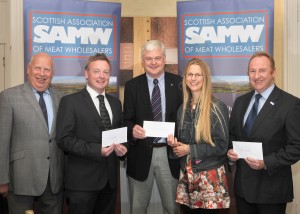
Alan McNaughton, SAMW vice-president presents cheques to CLIC Sargent (£1500); Marie Curie Cancer Care (£1500) and MND Scotland (£2000). Pictured (left to right) are: Ian Anderson (SAMW Executive Manager); Richard Donald, CLIC Sargent; Alan McNaughton; Fiona Bushby, Marie Curie Cancer Care, and Craig Stockton, MND Scotland.
“One of the key parts of our work is to provide parents with somewhere to stay close to their children during what can be a lengthy treatment process,” said Richard Donald, Fundraising Manager for CLIC Sargent.
“This is particularly important for rural families who are located some way from central Scotland where most treatments take place. We’re currently establishing new accommodation options in Glasgow, in fact, due to a re-location of the city’s treatment centre. SAMW’s donation is a timely addition to our fund raising effort for this part of our programme.”
Rural support is also an important aspect of the work carried out by Marie Curie Cancer Care, whose core objectives include the desire to help people, who are approaching the end of their lives, to remain at home if they so wish.
“Working in partnership with NHS Grampian, we recently launched a new out-of-hours nursing service for Aberdeenshire and Moray, specifically to deliver nursing care for patients in their own homes,” said Fiona Bushby, Community Fundraiser for Marie Curie Cancer Care. “It’s highly appropriate that the donation from SAMW has come at a time when the new Aberdeenshire and Moray service is at such an early stage.”
MND Scotland Chief Executive, Craig Stockton, also mentioned his organisation’s community-based service when accepting the SAMW donation.
“Our five-person care team covers the whole of Scotland, including the islands, visiting those affected by MND in their homes with the aim of trying to ensure that people receive the care they and their families need,” he said. “Our newest member of staff joined us just this month, in fact, specifically to cover the North of Scotland, providing welfare and benefit support to people in the most rural parts of the country.”
“While any increase in beef numbers is obviously welcome the evidence of a long-term improvement, from today’s census figures, is extremely small,” said SAMW president, Alan Craig. “In that context, we would hope that the forthcoming CAP reform will be used by the Scottish Government to secure a more significant restoration of breeding numbers, providing meat plants with an essential and substantial increase in supplies.
“The census evidence regarding sheep, meanwhile, suggests that a turnround in production is beginning and we would hope that this indication proves accurate.”
Click census for further details
Any suggestion that the current review of the Food Standards Agency in Scotland could lead to differing forms of safety and labelling between Scotland and England are completely without foundation says the Scottish Association of Meat Wholesalers (SAMW).
“Raising fears about safety and labelling issues distorts what the review is actually about,” said Alan Craig, SAMW president.
“In July this year, we welcomed the Scottish Government’s decision to review FSA as a step which could give our industry efficient and cost-effective meat inspection, releasing member companies from a system which has become over-burdened by administrative costs and unacceptably high overheads. To even suggest that safety and labelling differences could be introduced as part of this process, therefore, merely serves to deflect attention from the industry’s core concerns over FSA’s inefficiencies.
“The truth in relation to safety and labelling is that our members will be looking to maintain standards as they are as a result of this review, a point which we have made several times in previous comments on this issue.
“SAMW is also well aware of the need for unity and common standards across country borders. Our member businesses have a combined turnover in excess of £1 billion. This is based on trade throughout the UK and Europe. There is no way we would ever wish to complicate this trade.
“All we want is a meat inspection system which is well managed, efficient and correctly costed. It’s not the safety and labelling standards which need to be changed, therefore, but the method of delivering those standards to our industry.”
Health and Safety guidance notes for the meat industry have been prepared by BMPA, along with other industry organisations, and the Health and Safety Executive.
Click here to access a detailed pdf version
SAMW president, Alan Craig, commented, as follows, on the European Commission’s move to introduce an electronic identification system (EID) for bovine animals on a voluntary basis.
“We welcome the general development but are mindful that while the UK’s current system is delivering the required results it involves significant administrative costs,” he said. “While moving to EID would appear to be the logical next step we need to learn from what others have achieved, particularly in the southern hemisphere, in delivering reliable EID results at an extremely competitive cost.
“In moving forward, however, consideration needs to be given to the UK transition period; potentially involving a significant overlap between our current system and EID and the costs attached to such a process. Ultimately, of course, the long-term objective must be to achieve improved efficiency and a competitive cost base.”
For full details of the Commission’s EID statement click here
SAMW has written to Dr Vincent Cable, in his capacity as chair of the Reducing Regulation Committee (RCC), giving him ‘chapter and verse’ on the Association’s view of the Food Standard Agency’s (FSA) proposals to charge the industry the full cost of meat hygiene inspections.
“The consultation on which the full cost recovery proposal was based was a false representation and gave no solid foundation on which to take decisions affecting the future of businesses and the employees who work there,” SAMW told Dr Cable, who’s committee is due to examine the FSA’s costing proposals shortly.
The Association letter, written on behalf of member companies with an aggregate annual turnover of more than £1 billion and employing more than 4000 staff directly, was signed by Ian Anderson, SAMW Executive Manager. He made the point that the FSA’s proposal was effectively asking the industry to ‘pay double for what are currently sub-standard goods from a monopoly supplier’. He also highlighted both the industry’s considerable export-earning value to the UK economy and the many challenges which member businesses are facing.
“On the economic front,” he wrote, “the red meat sector has an important place in the nation’s efforts to recover from the recession. The Coalition Government is on record as advocating that increased exports should be a major plank in its strategy. The Scottish red meat sector’s record in this respect is impressive with exports increasing by 40% between 2009 and 2010, and continuing that trend in 2011.”
However, he also wrote: “In recent weeks two of our members have ceased processing because their increased costs simply cannot be recouped from retailers.”
After explaining that the meat processing sector faces many external challenges which are increasing the possibility of business failures, he added that FSA charges, at the current level, were a significant factor in the recent business decisions to which he’d referrred.
“It is not difficult,” he went on, “to see how the introduction of full cost recovery as proposed by the FSA could greatly exacerbate this state of affairs.”
The letter, copied to Caroline Spelman, Secretary of State; James Paice, Minister of State for Agriculture and Food at Defra and Richard Lochhead, Cabinet Secretary for Rural Affairs and Environment at the Scottish Government, concluded with a ‘respectful request’ for the Committee to take SAMW’s members’ views into account in reaching its decision.
For the full text of the letter click here
Congratulations to Alistair Donaldson and Jim Royan on their successful ascent of Ben Nevis on August 9, from which they have raised an impressive £8000 for RSABI (formerly the Royal Scottish Agricultural Benevolent Institution) and the Worshipful Company of Butchers Master’s Charity (Farms for City Children).
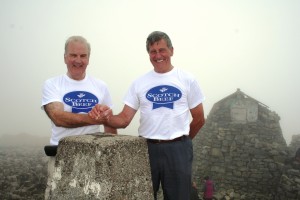
Jim (left) and Alistair relax at last on the typically misty summit of Ben Nevis
“We appreciate the tremendous support we’ve received from so many friends and colleagues across the whole of the meat sector,” said Alistair. “These are two excellent charities and it’s very satisfying to be able to help them in this way.
“Thank you again to everyone who contributed.”
Shetland Livestock Marketing Group (SLMG) has become the latest company to join SAMW.
Formed in 2004 and a community-based cooperative since 2010, SLMG is to open a new £500,000 abattoir in Lerwick later this season which, says SLMG chairman Ronnie Eunson, will ‘offer all Shetland businesses a great opportunity to source local meats processed to the highest standards’.
“I’m delighted that SLMG has joined us at this important time of challenge and change for the meat sector in Scotland,” said SAMW President, Alan Craig. “The Association promotes the interests of all members, always working to secure a better future for Scotland’s world class meat industry. It’s good to have expanded the northern edge of our representation and to be able to help provide SLMG with direct input into the decision-making processes in Edinburgh, London and Brussels.”
T: 07768 654955 E: scott.walker@scconsultancy.uk
© samw.org.uk - All rights reserved - Scottish Association of Meat Wholesalers | Privacy Policy