T. 07768 654955 E. scott.walker@scconsultancy.uk
Martin Morgan, former head of livestock policy for the Scottish Government, has been appointed as SAMW’s new Executive Manager, replacing Ian Anderson who is retiring after 10 years in the post.
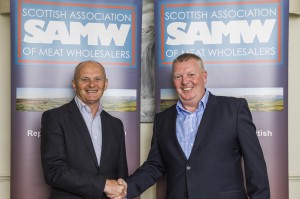
SAMW’s new executive manager Martin Morgan (left) with SAMW president Frank Clark
Having joined the Scottish Office in 1977, Martin comes to SAMW with extensive experience of red meat issues, including working on meat hygiene legislation in 1992, the BSE crisis from 1996 onwards and being part of the team involved in handling the UK’s foot and mouth outbreaks in 2001 & 2007.
“It was during that demanding period for the industry that I worked with Ian in the Scottish Government,” said Martin, who takes up his new post of November 1 st. “I’ve had a strong attachment to the red meat industry for more than 25 years and am delighted to be joining SAMW with the challenge of carrying on the good work that Ian has done.”
SAMW president, Frank Clark, agreed: “Ian has been extremely important to the association throughout his time as our executive manager, helping us negotiate many issues and developments over the last decade.
“In welcoming Martin, we believe we have another excellent executive manager who understands the red meat industry in Scotland with all its demands and also its great potential. With Brexit on the horizon, I am sure Martin will have a key role to play in helping our members address the challenges and opportunities which lie ahead.”
Martin and Ian will work together for an initial period of two months after which Ian will remain with the association on a consultancy basis until the conclusion of SAMW’s annual conference in April, 2018.
A new automated checking system to recognise the eligibility of Scottish cattle as having a minimal risk of BSE has been introduced.
The new system comes just months after Scotland achieved the lowest possible risk status level – negligible – for Bovine Spongiform Encephalopathy (BSE), in July 2017.
Commissioned by the Scottish Government and developed by ScotEID in partnership with industry and Food Standards Scotland, the checker uses data from the Cattle Tracing System to show the BSE status of every animal checked. This is a significantly more efficient system than the manual checks currently in use and will provide considerable new opportunities for the sector.
Announcing the news, Rural Economy Secretary Fergus Ewing said: “The early implementation of this automatic checking system is more great news for our meat sector and ensures Scotland’s excellent animal health status remains high on the agenda.
“Thanks to our successful partnership with industry, the new system is ready for operational use just months after we achieved the lowest possible status for BSE – negligible risk.
“The new system – which has been developed following years of hard work from the Scottish Association of Meat Wholesalers, producers, our red meat businesses, vets, and this government – is significantly more efficient than the manual checks currently in use and stands us in good stead to further increase Scotch Beef exports.”
Scottish Association of Meat Wholesalers Executive Manager, Ian Anderson said: “We warmly welcome this important development. The new checker is a fast, efficient and robust system which modernises the traditional methods of checking cattle ID and movement records. It will allow our members to provide their customers with a reliable data source, contributing further to the world class image and provenance of Scotch beef.
“We also appreciate the efficiency with which the new system has been developed and tested, following Scotland’s success in gaining the lowest possible risk status for BSE in July this year. It is important for Scotland’s meat industry that we maintain maximum momentum in exercising the trading advantages we have over countries which currently don’t share our negligible risk status and the new checker will help us do that.”
Born: April 20, 1934
Died: April 21, 2017
John Scott was born at home at Barr farm, Skelmorlie on 20th April 1934, the second of three children to James and Elspeth Scott. He attended Skelmorlie Primary and Largs High Schools, was an active member of the Boy Scouts and when he left school at 16 he became the sixth generation of Scott’s to farm in Skelmorlie. John was only 22 when his father died and he assumed all of the responsibilities which came with running the farm.
At that time the farm was a small community supporting many people. However agriculture was going through many changes, tractors were taking over from horses, food rationing was coming to an end and electricity was now in regular supply. In his late teens John had already realised that there were opportunities out there and had started to look for ways to make extra money. He decided to buy 100 chickens and looked after them until point of lay, at which point he sold 25 of them which enabled him to buy another 100 chickens and so it was that he very quickly developed a business with an egg run supplying the butchers shops in Greenock, of which at that time there were 35. It was not long before he also began supplying them with cattle and sheep both from his own farm and also local markets. The foundations of John Scott Meat were being built. The supply of meat operated from Greenock abattoir until 1968 when it was destroyed in a storm. John managed to secure other facilities at Dumbarton abattoir and then moved five years later to modern premises at Paisley abattoir, where the Company still operates from to this day. Paisley was very well located for business. In 1978 when the local council decided that the abattoir was no longer viable for them to operate John and two others seized the opportunity to take over the business from the local council and Sandyford Abattoir (Paisley) Ltd was formed with John Scott as Chairman.
The early years were tough and the improvements and progress made at home on the farm are a tremendous legacy to the man John Scott was. He married Elsie Mitchell in 1959 and moved into Thirdpart Farm. Two daughters Hazel and then Gillian were born a few years later, followed by a son Jamie in 1967. He enjoyed holidays abroad, in the early days with the family and then Elsie and he enjoyed farm study tours and exploring different parts of the world. He was a great family man and the greatest blow to him was the loss of his daughter Gillian to cancer in 2005.
In his public life he was a staunch supporter of the Scottish Meat Industry particularly smaller operators and contributed significantly to various issues of the day …..all vital at the time. He made a sound contribution to the Guild of Scotch Quality Meat Suppliers (GSQMS) which was the precursor of all the quality assurance schemes set up in Scotland. As such it had a prolonged gestation and John helped nurse it through the early days to eventual success at a time when clearly defined abattoir standards became a vitally important part of promoting the Scotch Label. Perhaps his greatest contribution was as SAMW President. In 1993 he took over as President from Alan Stevenson who then became Executive Manager of SAMW and together they developed SAMW into a very effective lobbying force in the corridors of power and to this day it is punching well above its weight in Scotland, London and Brussels. The combination of John’s experience with smaller abattoirs and Alan’s which lay with larger organisations smoothed the path for establishing SAMW and making it a force to be reckoned with in dealing with the very difficult problems of the 90’s. BSE, FMD and legislation.
Although John handed over the reigns of John Scott Meat to Hazel and Jamie in 2007, he always maintained an interest in the meat industry and up until last year he was still a familiar face around the livestock ring. Laterally he was happiest at home on the farm where he had overseen many improvements to the land and enjoyed nothing more than checking the livestock.
He was a well respected man and the large turnout at his funeral at Skelmorlie and Wemyss Bay Parish Church which was filled to capacity was a great testament to the high regard in which he was held.
He is survived by his wife of 57 years Elsie, daughter Hazel, son Jamie and his grandchildren John, Scott, Nicola, Jason and James.
The successful granting to Scotland of negligible risk status for BSE, approved today (Thursday, May 25) by the World Organisation for Animal Health (OIE) Scientific Commission, has been welcomed by the Scottish Association of Meat Wholesalers (SAMW) as a vitally important step for the whole Scottish red meat industry.
“Scotland has lived with BSE since 1986 and the farming and meat industries have made massive efforts to manage and eradicate the disease. Today’s decision frees our industry to make full commercial use of Scotland’s high-health status on behalf of producers, processors and wholesalers, opening the door to fresh marketing opportunities around the world,” said SAMW president, Frank Clark.
“Having originally launched Scotland’s campaign for negligible risk status early last year, based on the fact that the last confirmed BSE case in Scotland involved an animal born in 2002, SAMW is delighted to have achieved this and be now able to celebrate the OIE’s decision.
“By confirming Scotland’s fully justified new status, the OIE has given our industry a new platform from which to rebuild. The value of the Fifth Quarter (hides, offal and other by products) disappeared overnight and previously saleable materials became waste. The loss of revenue and vastly increased waste disposal costs had a severe financial effect on the industry. Our improved BSE status will remove a potential barrier to trade, unlocking sales opportunities in markets which are keen to buy Scottish meat but only accept products from negligible risk areas. We now have that status and will be seeking to renew trading routes accordingly.”
Mr Clark also paid tribute to the support given to the industry’s case throughout the OIE process by Scotland’s Cabinet Secretary for Rural Economy and Connectivity, Fergus Ewing, and his officials, who provided OIE with a wealth of statistics and information, detailing every aspect of the country’s sustained freedom from BSE.
“Once the campaign began, the Cabinet Secretary, his officials and all Scotland’s food and farm bodies worked together to deliver today’s decision, which is of such great importance to the whole industry” said Mr Clark.
The addition of a new red meat member to SAMW has further enhanced the united representation of the Scottish processing industry, giving the sector a strong voice as the country embarks on its Brexit negotiations.
The Association has also added its first venison processor to its membership, a move which strengthens the industry’s hand in working with the UK and Scottish governments and other representative bodies.
The new red meat member is the Lockerbie-based Border Meats business while the venison member is Highland Game, whose headquarters are in Dundee.
“We’re delighted to welcome both of our new members, especially coming at a time when the strongest possible representation of the industry’s views will be needed as we seek to establish a progressive base for Scotland’s meat industry outside the EU structure which we have known for so many years,” said SAMW president, Allan Jess.
“In welcoming Border Meats, we now have almost 100% representation of the red meat processing industry in Scotland, with only a few small island plants not being SAMW members. This gives us the platform from which to speak with one voice on behalf of the industry which plays such an important part in the maintenance and development of the whole red meat chain in Scotland.
“The addition of Highland Game is an equally positive development for us. Despite the species difference involved, the core business and regulation issues we face are often the same, which again allows us to represent Scotland’s position from a strong and united base.”
A strong line-up of speakers will address SAMW’s annual conference in Glasgow on April 22, tackling the event’s core theme of Beyond Brexit’

Fergus Ewing MSP
The keynote conference speech will be given by the Cabinet Secretary for Rural Economy and Connectivity, Fergus Ewing.
First elected as MSP for Inverness East, Nairn & Lochaber in 1999, he has been responsible for Rural Economy and Connectivity since May 2016.
He previously held Ministerial responsibility for Business Energy & Tourism.

James Withers
The second speaker is James Withers who became Chief Executive of Scotland Food & Drink in 2011, overseeing the industry’s growth towards its current value of £16.5 billion.
He previously spent 12 years with the National Farmers Union Scotland, being the organisation’s CEO from 2008 to 2011.
Jim McLaren will then deliver a presentation focusing on Quality Meat Scotland’s future work programme.

Jim McLaren
Appointed Chairman of QMS in April 2011. Jim McLaren runs a mixed arable and livestock business in Perthshire. His main arable enterprise is the production of spring malting barley, with the livestock side of the business including a pedigree Simmental herd.
He was NFU Scotland President from 2007 to 2011.
Dr George Burgess, who recently took up a new post in the Scottish Government, leading on Food, Drink and Trade, with particular emphasis on the outcome of the EU referendum, will address the conference on trade issues.

George Burgess
Prior to this, he was Head of the Environmental Quality Division from 2011, where his responsibilities included waste and resources, radioactive materials, the water environment, flooding and reservoirs, sponsorship of the Scottish Environment Protection Agency and better environmental regulation.
Finally, speaking on behalf of UK Export Certification Partnership, Martin Williams will outline the current focus of the Defra/industry partnership.
UKECP lists its responsibilities as: Liaising with the UK livestock and livestock products industries to establish export market priorities; providing a forum to discuss the use of Defra agents to negotiate export health certificates on behalf of the UK; and assisting in the drafting of export health certificates which are generally required before exports can take place.
Full conference and dinner dance details
Date – Saturday, April 22, 2017
Venue – Marriott Hotel, 500 Argyle Street, Glasgow
Conference times:
9.45 – coffee
10.15 – Conference opening by SAMW president
13.00 – Lunch
Dinner & Dance
19.00 start
The Scottish Association of Meat Wholesalers (SAMW) has welcomed the World Organisation for Animal Health (OIE) Scientific Commission recommendation for Scotland to be recognised as an area of negligible risk for BSE. The Scientific Commission’s recommendation will now be considered by the OIE World Assembly in May.
“This is the highest recommendation which is available to any country, establishing a disease-free status which was first requested through a detailed paper setting out the case for change which SAMW submitted, and other Scottish meat and livestock organisations supported, to the Scottish Government in February 2016,” said SAMW president, Allan Jess. “Our initiative was the beginning of a process which is now set to deliver many major benefits for everyone involved in Scotland’s livestock and meat industry.
“The OIE breakthrough which has now been secured is fully justified by the fact that the last confirmed BSE case in Scotland involved an animal born in 2002.”
Mr Jess added that the potential benefits to the Scottish industry of being elevated to ‘negligible risk’ status for BSE will include:
“We applaud the work done by the Cabinet Secretary for Rural Economy and Connectivity, Fergus Ewing, and his officials, in advancing and pursuing the ‘negligible risk’ case on the industry’s behalf and look forward to being free to trade under our new status by as early as the summer,” said Mr Jess.
SAMW made the following statement in response to press questions, generated by Quality Meat Scotland’s latest Brexit briefing paper:
SAMW said: “The challenge for Government during the next two years of Brexit negotiations is to ensure that trading routes into the EU remain open, even if that involves a certain degree of change and adjustment in the way in which that trade operates.
“If such a settlement can be delivered, albeit outside the single market, we’re confident the opportunity to sell Scotland’s high quality red meat to EU customers will continue, based on the hard-earned reputation of our product and the commitment of existing buyers to Scotch meat as a ‘top-end’ item on restaurant menus.
“Trading into the EU may present more challenges for SAMW members in the post-Brexit era, of course, as the QMS report rightly warns. However, while much will depend on the settlement which the Government is able to deliver, SAMW member companies will continue to seek relevant and profitable EU business throughout the next two years and beyond.
“In addition, in the midst of the Brexit changes, it is important that Government recognises the opportunities that exist for home-produced growth within the UK itself. The UK meat market is a long way short of being self-sufficient, a fact which means there should be greater opportunities for domestic expansion, especially by Scottish suppliers.
“As the QMS report states, two-thirds of Scotch meat is ‘exported’ to the rest of the UK, making it our most important trading outlet. It will be vital, therefore, that in negotiating the UK’s post-Brexit deals, with the EU and other existing and new trading partners around the world, the UK market is given proper and effective protection against inferior, poor welfare and poor hygiene imports from other countries.
“Brexit will produce changes but they don’t all have to be negative, provided the Government secures the right deal for UK producers, processors, wholesalers and retailers.”
T: 07768 654955 E: scott.walker@scconsultancy.uk
© samw.org.uk - All rights reserved - Scottish Association of Meat Wholesalers | Privacy Policy