T. 07768 654955 E. scott.walker@scconsultancy.uk
The launch of Food Standards Scotland (FSS) is a fresh start opportunity to create a high grade, high trust and high standard industry which is working together and pulling in the same direction, SAMW president, Alan McNaughton, told members and guests during his address to the Association’s annual conference in Glasgow.
“That’s a change which we should all celebrate,” he said, adding that while there will obviously be points to ‘discuss between our two organisations’ in the future, the arrival of FSS was a welcome step.
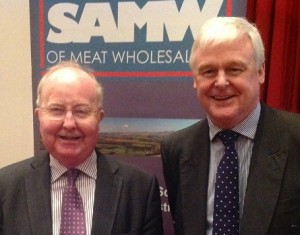
Ross Finnie, FSS chairman (left) with Alan McNaughton, SAMW president
“It’s extremely good to be able to start working with an open and accessible food standards body, freed, as FSS is, from the rigid and inflexible remoteness which so often controlled the former structure,” he said.
“We also remain confident, that the new body will be successful in stripping out costs in comparison to the old system.”
Ross Finnie, chairman of FFS, and a keynote speaker at the conference, said that ‘effective partnership working and stakeholder engagement’ were important factors in the development of the new body. He also said FSS would take ‘intelligence-led approaches to delivery that are risk-based with proportionate enforcement’ if required.
“By working together we can deliver great performance for consumers,” he told conference delegates.
The chosen title for SAMW’s annual conference in Glasgow is ‘New horizons’, a theme which will be addressed by Association president, Alan McNaughton, and four top level speakers:
* Ross Finnie, Chairman, Food Standards Scotland
* Frank Strang, Head of Food and Drink Policy, Scottish Government
* Richard Brown, Director of GIRA (Global Market intelligence)
* Mark Thomson, Business Unit Director, Kantar Worldpanel
The launch of Food Standards Scotland on April 1, makes this a particularly key point for the industry and we’re delighted that Ross Finnie has agreed to address our conference. The input from Mark Thomson and Richard Brown is also extremely well-timed, given the changing nature of the UK’s retail chains and the challenges of the European marketplace. We also look forward to Frank Strang’s presentation which will examine the prospects for the red meat sector with particular reference to beef.
Full conference and dinner details:
Date – Saturday, April 18, 2015
Venue – Marriott Hotel, 500 Argyle Street, Glasgow
Conference times:
9.45 – coffee
10.15 – Conference opening by SAMW president
13.00 – Lunch
Dinner & Dance
19.00 start
Scotland’s meat industry leaders are looking for positive action on two key fronts this year, a major meat trade, farming and food sector gathering was told in Edinburgh.
“Delivering practical results from last year’s Beef 2020 Report and the commissioning in April of Food Standards Scotland (FSS) are the development highlights which we believe can give fresh impetus to Scotland’s meat chain this year,” said SAMW president, Alan McNaughton.
Speaking after hosting a New Year seminar and lunch in Edinburgh, attended by 60 government and business leaders covering the meat trade, farming and food sectors, Mr McNaughton said the Beef 2020 Report was an excellent piece of work, for which the 2015 challenge was to deliver the right investment and growth opportunities for the beef chain.

Alan McNaughton (left) with Geoff Ogle at the New Year event
On the prospect of working with the new FSS, he commented that SAMW was looking forward to building a ‘constructive, fruitful and beneficial relationship’ with the new organisation to secure better outcomes for consumers and industry than has been achieved in the past.
“On both fronts, there are extremely positive opportunities which government and the food and farming industry need to grasp with both hands this year,” he said. “SAMW will certainly be playing its part in seeking to maximise the impact of these two key developments.”
Appropriately, given the president’s comments, the SAMW event was addressed by Geoff Ogle, Director of the Food Standards Agency in Scotland until the end of March, and Chief Executive designate of FSS from April 1, and Jim McLaren, Chairman of Quality Meat Scotland and the driving force behind Beef 2020.
Former SAMW president Isla Roebuck is into serious growth this month in the upper lip department. 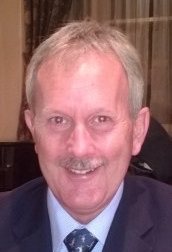
It’s all part of the Movember Foundation’s work to raise awareness of prostate cancer and generate essential funding for research. To support Isla and his admirable moustache click on the following link.
Or, if you prefer, send a cheque to ‘Movember Europe’, referencing Isla’s registration ID: 11720789 and posting it to: Movember Europe, PO Box 3, Diss, IP98 1HH
Three major charities, Sarcoma UK, Alzheimer Scotland and Scottish War Blinded have shared gifts totalling £8000 from the Association, drawing on funds raised during a charity auction at the 2014 conference and dinner.
“The auction is a long-standing feature of our annual dinner, with members and guests at this year’s event coming together to enable us to make a contribution to the important work being carried out by these three excellent charities,” said SAMW president, Alan McNaughton.

(l-r) Sam Patton, Sarcoma UK; Marjory Kirkwood, Scottish War Blinded; Alan McNaughton, SAMW President; Claire Turner, Alzheimer Scotland, and Ian Anderson, SAMW Executive Manager.
Sarcoma UK (£3000)
Sarcomas are rare cancers, most commonly developing in muscles and bones, although there are around 100 different types. There are currently around 13,000 people living with sarcoma in the UK, with 3,800 new cases emerging every year.
“The overall five-year survival rate is roughly 55%, much lower than for other types of cancer, but would be greatly improved with earlier reporting and diagnosis,” said Sam Patton, Consultant Orthopaedic Surgeon at Edinburgh’s New Royal Infirmary, who received the SAMW cheque on behalf of the charity.
“While breast cancers are now identified, on average, when they’re the size of a grape, sarcomas tend not to reach the medical profession until they’re the size of a baked bean tin. If we could see them before they reach golf ball size we could improve survival rates by 20%. Gifts such as this from SAMW will help greatly in getting this message out to people and in our research work.”
Mr Patton is a member of Sarcoma UK’s Research Advisory Committee.
Alzheimer Scotland (£2,500)
Alzheimer Scotland depend on gift income to maintain and develop their work and services to help improve the quality of life for the 88,000 people in Scotland living with dementia.
“The funds raised by SAMW will go some way towards helping us make sure that no one goes through dementia on their own, by supporting our Dementia Advisors Programme,” said Claire Turner, Trusts and Corporate Fundraising Manager, Alzheimer Scotland. “These dementia specialists work in local communities throughout Scotland, offering one-to-one, personalised care and support for people with dementia, helping them to maintain independence, plan for the future and live well with dementia.”
Scottish War Blinded (£2,500)
Scottish War Blinded today provides free support to former members of the Armed Forces that have lost their sight in a war, as well as those who have lost their sight subsequently.
Scottish War Blinded supports members through the Linburn Centre and Outreach services:
The Linburn Centre, located in Wilkieston, West Lothian accommodates up to 35 members a day who can attend Monday to Friday for a range of activities, rehabilitation, independent living skills and social outings.
Scottish War Blinded has eight Outreach Workers across Scotland providing a one-stop contact point for dealing with statutory and voluntary agencies, specialist equipment provision, mobility and independent living support and introducing social opportunities.
Following the recent airing of a BBC Scotland on red meat processing, SAMW has written to the Cabinet Secretary for Rural Affairs and the Environment, Richard Lochhead, to ‘put the record straight’. The full text of the letter follows:
SAMW is concerned that the wrong impression of the Scottish red meat processing sector was conveyed by the ‘Scotland 2014’ programme, which was broadcast by BBC Scotland on 2 July. We could catalogue a long list of erroneous or misleading statements and assertions made during the programme but we shall limit our comments to the main points.
The film of abattoir abuse was several years old and did NOT take place in a Scottish abattoir. The ex-slaughterhouse employee, who commented on the basis of his experience at a small Scottish abattoir which closed some years ago, displayed ignorance of the industry by referring to welfare issues at the de-hairing stage when the pig is already DEAD. The programme lacked credibility and was demonstrably partial in its approach to the Scottish abattoir sector. Thankfully, the efforts of SAMW and QMS to present the sector in a proper light paid off through the briefing of Johnny Mackey, who restored balance and fact to the programme.
Programmes such as Scotland 2014, however poor and inaccurate they may be, are seldom without consequences. Clearly, with an industry we are justly proud of, we are anxious to minimize these. There must be no knee-jerk reaction by government to address a problem which arguably doesn’t exist and care needs to be taken to avoid unnecessary measures so that authority can be “seen to have taken action.”
The red meat processing sector has a good record on animal welfare and this should not be overlooked. Of course, welfare incidents can arise but these usually result from unavoidable or unforeseen events and are addressed immediately. As Johnny Mackey said in his interview, it is not in the interests of the Scottish industry to have poor welfare because of the impact it would have on meat quality and the good reputation and image of ‘Scotch’ in the market place. This association therefore supports high standards of animal welfare and the taking of strong action if any wilful, unacceptable practice should occur. In our experience, the Food Standards Agency in Scotland enforces the welfare legislation robustly and we have no doubt that the industry will address very seriously any issues which might arise in the future. In view of this, we are concerned that there should be no reflex draconian action as a consequence of the BBC programme.
Another issue which was poorly portrayed in the programme was the use of CCTV in abattoirs. As Johnny Mackey said, 95% of all red meat animals slaughtered in Scotland are in plants which already have CCTV. Furthermore, we understand that the abattoirs accounting for the remaining 5% were not responsible for any recent breaches of welfare. Thus, there is no case for compulsory CCTV, a view reached a few months ago by the Scottish Parliament Cross Party Group on Animal Welfare, chaired by your colleague Christine Graham MSP. That group favours guidance and best practice rather than legislation and this seems a wiser course as the use of CCTV raises a multitude of difficult practical and legal issues. A potential major concern is the additional costs which could fall on abattoirs at a time when the red meat industry is under severe financial pressure.
Finally, the BBC programme highlighted our long standing concern over the movement of animals back from abattoirs to the consignor. You kindly met a delegation from SAMW to discuss this last September. The programme repeatedly referred to heavily pregnant animals and animals which had recently given birth being slaughtered. If the farmers send them to the abattoir in these circumstances, what else can the abattoir do if the Scottish Government will not allow them to be sent home? Of course, the abattoir can apply for a specific movement licence but the delay in obtaining this will most likely exacerbate the problem. In these circumstances, a general licence would seem more appropriate.
We would welcome your comments on these points and would be pleased if you would agree to discuss them with the association.
Signed
Ian Anderson
Executive Manager
T: 07768 654955 E: scott.walker@scconsultancy.uk
© samw.org.uk - All rights reserved - Scottish Association of Meat Wholesalers | Privacy Policy